FIFA 2026 WORLD CUP
FIFA World Cup 2026: The Ultimate Guide to the Historic 48-Team Tournament

The global football landscape is shifting, and all eyes are locked on North America. The FIFA World Cup 2026 is poised to be the largest, most ambitious, and most diverse sporting event in human history. Jointly hosted by three powerhouse nations—the United States, Canada, and Mexico—this tournament will break decades-old traditions, introduce a groundbreaking format, and bring the beautiful game to unprecedented heights.
Whether you are a die-hard soccer fan, a casual sports enthusiast, or a traveler planning your next big adventure, this comprehensive guide covers everything you need to know about the 2026 FIFA World Cup. From the revolutionary 48-team expansion to the iconic stadiums and key match dates, here is your ultimate roadmap to soccer’s biggest spectacle.
1. A Historic Tri-Nation Host: United 2026
For the first time in FIFA history, three nations will share hosting duties. Dubbed the "United 2026" bid, the collaboration between the United States, Canada, and Mexico highlights the unifying power of soccer.
While the tournament will span an entire continent, each host country brings its own unique footballing heritage to the table:
- Mexico: A nation with a deep, poetic relationship with football. Mexico makes history as the first country to host the FIFA World Cup three times (previously hosting in 1970 and 1986).
- United States: Hosting for the second time (previously in 1994), the US aims to capitalize on the massive growth of Major League Soccer (MLS) and solidify soccer’s position in the American mainstream sports market.
- Canada: This marks Canada’s first time hosting the men’s FIFA World Cup, building on the phenomenal success of hosting the FIFA Women’s World Cup in 2015.
By uniting these three vast nations, FIFA is creating a continental festival of football that will bridge cultures, time zones, and communities.
2. The Revolutionary 48-Team Format Explained
The defining feature of the FIFA World Cup 2026 is the historic expansion of the tournament. Moving away from the traditional 32-team format that has been in place since 1998, the 2026 edition will feature 48 competing nations.
This expansion is a monumental shift designed to give more countries from developing football regions—particularly Africa, Asia, and North America (CONCACAF)—a chance to shine on the world stage.
How the New Group Stage Works
With 48 teams qualified, FIFA has redesigned the tournament structure to maintain high-stakes drama while accommodating the extra matches:
- 12 Groups of 4: The teams will be divided into 12 groups of four teams each.
- The Knockout Progression: The top two teams from each group, along with the eight best third-place finishers, will advance to a brand-new Round of 32.
- More Matches, More Drama: The total number of matches will skyrocket from 64 to 104 matches. The tournament duration will span roughly 39 days, meaning fans will enjoy a feast of non-stop football.
- The Path to Glory: To lift the coveted trophy, the eventual champions will now have to play eight matches instead of the traditional seven.
This format ensures that the group stage remains highly competitive, minimizing the risk of collusion and keeping fans on the edge of their seats until the final group-stage whistle blows.
3. Host Cities and Iconic Stadiums
The 2026 tournament will be played in 16 world-class venues across North America. These stadiums have been meticulously selected for their state-of-the-art infrastructure, massive capacities, and accessibility.
| United States (11) |
Mexico (3) |
Canada (2) |
| New York/New Jersey |
Mexico City |
Vancouver |
| Los Angeles |
Monterrey |
Toronto |
| Dallas |
Guadalajara |
|
| San Francisco (Bay Area) |
|
|
| Miami |
|
|
| Atlanta |
|
|
| Seattle |
|
|
| Houston |
|
|
| Philadelphia |
|
|
| Kansas City |
|
|
| Boston |
|
|
Spotlight on Key Venues
- Estadio Azteca (Mexico City): A cathedral of world soccer. Having witnessed Diego Maradona’s "Hand of God" in 1986 and Pelé’s masterclass in 1970, this legendary 87,000-seat stadium will host the opening match of the tournament on June 11, 2026.
- MetLife Stadium (New York/New Jersey): Located in East Rutherford, New Jersey, this massive venue has been officially selected to host the FIFA World Cup 2026 Final on July 19, 2026. It offers a spectacular backdrop with proximity to New York City.
- AT&T Stadium (Dallas/Arlington): Featuring a retractable roof and one of the largest high-definition video screens in the world, this venue will host a highly anticipated semi-final match.
- BC Place (Vancouver): Renowned for its stunning cable-supported roof and picturesque location, Vancouver will serve as a primary hub for matches played on the scenic West Coast.
4. Key Dates and Tournament Schedule
Mark your calendars! The FIFA World Cup 2026 schedule is designed to minimize travel for teams and fans by grouping matches into regional clusters (West, Central, and East).
- June 11, 2026: The opening match kicks off at the historic Estadio Azteca in Mexico City.
- June 12, 2026: The first matches in Canada (Toronto) and the United States (Los Angeles) take place, officially launching the tournament across all three host nations.
- June 11 – June 27, 2026: The Group Stage. With 104 matches in total, expect up to four games a day.
- June 28 – July 3, 2026: The brand-new Round of 32 knockout phase.
- July 4 – July 7, 2026: The Round of 16.
- July 9 – July 11, 2026: The Quarter-finals.
- July 14 – July 15, 2026: The Semi-finals (hosted in Dallas and Atlanta).
- July 18, 2026: The Third-Place Play-off (Miami).
- July 19, 2026: The FIFA World Cup Final at MetLife Stadium, New York/New Jersey.
5. How to Get Tickets for the 2026 World Cup
Demand for 2026 World Cup tickets is projected to break all previous records. Because matches are spread across major metropolitan areas with massive tourism infrastructure, millions of international fans are expected to travel.
To secure your spot in the stands, follow these essential steps:
- Register on the Official FIFA Portal: Go to the official FIFA website and register your interest in tickets. This ensures you receive real-time updates on sales phases, random selection draws, and last-minute ticket releases.
- Understand the Sales Phases: Tickets are typically sold in phases. The first phase usually operates on a Random Selection Draw (lottery) system, followed by a "First-Come, First-Served" phase.
- Plan for Hospitality Packages: If you want a guaranteed seat coupled with premium dining, lounge access, and exclusive perks, look into official FIFA hospitality packages. While more expensive, they offer a seamless booking experience.
- Beware of Secondary Markets: Only purchase tickets through official FIFA channels. Unauthorized ticket resellers risk selling counterfeit tickets that will be deactivated at stadium turnstiles.
6. The Long-Term Legacy: What This Means for North American Soccer
The impact of the FIFA World Cup 2026 will extend far beyond the final whistle on July 19. The tournament is projected to generate billions of dollars in economic activity, create thousands of jobs, and leave a lasting cultural legacy.
The Soccer Boom in North America
Historically, the United States and Canada have prioritized traditional sports like American football, basketball, hockey, and baseball. However, the demographic landscape is rapidly changing. The 2026 tournament will act as a catalyst, accelerating interest in soccer at the grassroots level.
- Youth Development: Increased funding and infrastructure investments will pave the way for academy expansions, giving young North American talent a direct pathway to professional leagues.
- MLS & Liga MX Synergy: The collaboration between Major League Soccer (MLS) and Mexico's Liga MX will likely intensify, creating a highly competitive North American soccer ecosystem capable of rivaling European leagues.
- Tourism and Infrastructure: Host cities are already upgrading public transit systems, airport terminals, and hospitality sectors to accommodate the influx of global travelers, leaving behind modernized cityscapes for residents.
Conclusion: The Countdown is On
The FIFA World Cup 2026 is more than just a sports tournament; it is a celebration of human connection, athletic excellence, and cultural exchange. By expanding to 48 teams and spanning three massive nations, FIFA is creating an inclusive global festival that will inspire a new generation of players and fans.
From the high-altitude passion of Mexico City to the vibrant coastal energy of Vancouver and the glittering skyline of New York, North America is ready to welcome the world. Start planning your journey today, register for tickets, and prepare to witness history in the making. The road to 2026 has officially begun!
Canada Makes History! Jonathan David's Stunning Hat-Trick Demolishes Qatar 6-0 at World Cup 2026

There are nights, and then there are nights like this. On a thundering Thursday evening at BC Place, Canada didn't just win a football match — they rewrote their entire World Cup story. A merciless 6-0 demolition of Qatar, capped by a sensational Jonathan David hat-trick, handed the co-hosts their first-ever victory at a men's FIFA World Cup finals, and nobody inside Vancouver's roaring stadium will ever forget it.
If you missed the chaos — red cards, a scary injury, a Prime Minister in the stands, and a striker reborn — here's everything you need to know about the result that just changed Canadian football forever.
⚡ Quick Match Facts
- Competition: FIFA World Cup 2026 – Group B
- Venue: BC Place, Vancouver, Canada
- Attendance: 52,497
- Final Score: Canada 6 – 0 Qatar
- Man of the Match: Jonathan David (hat-trick)
- Goal scorers: Cyle Larin (16'), Jonathan David (29', 45+1', 90+2'), Nathan Saliba (64'), Mohamed Manai own goal (75')
- Red cards: Homam El Amin (Qatar, 1st half), Assim Madibo (Qatar, 2nd half)
- Result impact: Canada move top of Group B with 4 points from two matches
How the Rout Unfolded
First Half: Larin Lights the Fuse, David Takes Over
Canada needed just 16 minutes to settle the nerves of a packed home crowd. Veteran forward Cyle Larin pounced on a rebound to slot home the opener, sparking the first roar of the night.
Thirteen minutes later, Jonathan David turned a good night into a great one. He met the ball on the volley and sent it screaming past Qatar goalkeeper Mahmoud Abunada for an outrageous second goal that had even neutral fans on their feet. Before the half-time whistle, David struck again, turning a comfortable lead into a statement: Canada went into the break 3-0 up and completely in control.
Second Half: Red Cards, an Injury Scare, and a Free-Kick Tribute
The chaos intensified after the break. Qatar were left to rue a horror passage of play when Assim Madibo was sent off for a reckless tackle that left Canadian midfielder Ismael Kone with a serious lower-leg injury, forcing him off on a stretcher. It followed an earlier first-half red card for Homam El Amin for a last-man foul on Tajon Buchanan — leaving Qatar to play out most of the match with nine men.
Canada's response to their teammate's injury was emotional and emphatic. Substitute Nathan Saliba, who had replaced Kone, curled home a brilliant free-kick in the 64th minute and immediately held up Kone's jersey in tribute. Eleven minutes later, defender Mohamed Manai turned a Jacob Shaffelburg effort into his own net to make it 5-0.
Then, deep into stoppage time, the moment everyone had been waiting for: Jonathan David completed his hat-trick to seal a historic 6-0 final score and send BC Place into delirium.
Records Falling Left, Right and Centre
This wasn't just a big win — it was a night for the history books:
- 🏆 Canada's first-ever win at a men's FIFA World Cup finals, after decades of near-misses and heartbreak.
- ⚽ Jonathan David became the first player to score a World Cup hat-trick on host-nation soil since England's Geoff Hurst in 1966.
- 🌍 David is only the second non-European/non-South American player in World Cup history to score a hat-trick, joining USA legend Bert Patenaude (1930 vs. Paraguay).
- 🐐 David's treble puts him alongside Lionel Messi as one of only two players to score a hat-trick at the 2026 World Cup so far.
- 📊 The 6-0 scoreline equals the biggest-ever winning margin by a World Cup host nation, matching Italy (1934), Brazil (1950) and Argentina (1978).
- 🔢 Remarkably, Canada's six goals against Qatar were enough to double their entire World Cup goal tally heading into the match.
- 🟥 Qatar became the first Asian nation to have two players sent off in a single World Cup match.
"No One Will Forget This" — Jesse Marsch
Head coach Jesse Marsch couldn't hide his emotion after the final whistle, holding up six fingers as he walked off the pitch. Reflecting on what the win meant for the country, he simply said: "No one will forget this, and no Canadian will forget this day."
The result carried extra weight in the stands too — Canadian Prime Minister Mark Carney was in attendance, watching his country make football history live after missing the tournament opener due to G7 commitments.
What's Next for Canada?
The win launches Canada to the top of Group B on four points from two matches, following their opening 1-1 draw with Bosnia-Herzegovina in Toronto. Captain Alphonso Davies and defender Moise Bombito both returned to availability after injury, adding depth ahead of a decisive final group-stage clash against Switzerland. A draw — or better — will be enough to confirm top spot and a strong path into the Round of 32.
For Qatar, the picture is bleaker: a chaotic, undisciplined performance leaves their knockout hopes hanging by a thread heading into their final group fixture.
Final Whistle Thoughts
Six goals. A hat-trick for the ages. A nation's first-ever World Cup win, delivered in front of its own fans, on home soil, in the most emphatic way imaginable. Jonathan David's name is now etched into World Cup folklore alongside Messi and Patenaude — and Canadian football has a new defining moment to build a legacy on.
This is the kind of result that doesn't just win a match. It changes belief.
World Cup 2026 Shatters All-Time Attendance Record — 281,223 Fans Pack Stadiums in a Single Day
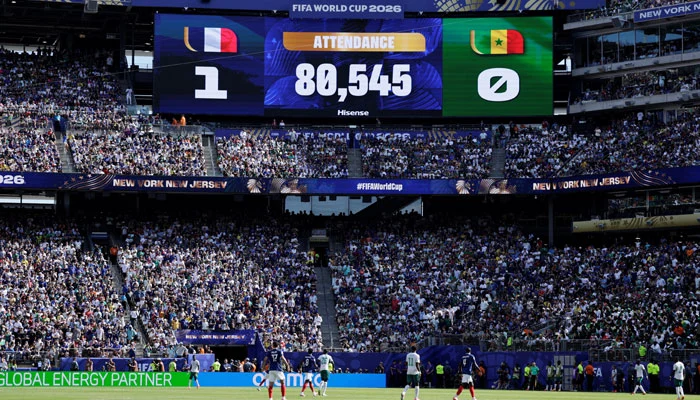
Football just proved, once again, that it's the only language the entire world speaks fluently. On June 16, 2026, an astonishing 281,223 fans streamed through turnstiles at four different stadiums across North America — officially making it the most-attended single day in FIFA World Cup history, smashing a record that had stood for 32 years.
And the most jaw-dropping part? This tournament isn't even past the group stage yet.
⚡ Quick Record Facts
- New record: 281,223 fans in a single day (June 16, 2026)
- Previous record: 277,070 fans, set June 28, 1994 in the USA
- Matches played that day: France vs. Senegal, Argentina vs. Algeria, Austria vs. Jordan, Iraq vs. Norway
- Cumulative attendance (first 6 days): 1,309,652 fans
- Average attendance per match: 65,483
- All-time cumulative record on the line: 3.5 million (set in 1994) — expected to fall by the end of the group stage on June 27
How the Record Was Broken
Four blockbuster fixtures pushed the number past the old 1994 mark, and each one delivered star power to match the crowds:
- France 3-1 Senegal at MetLife Stadium in East Rutherford, NJ — roughly 80,545 fans watched Kylian Mbappé score twice to power France to victory.
- Argentina 3-0 Algeria in Kansas City — nearly 69,045 fans witnessed a sensational Lionel Messi hat-trick.
- Austria 3-1 Jordan in the Bay Area — 68,527 fans turned out for the upset-laden clash.
- Norway 4-1 Iraq in Foxborough, MA — about 63,106 fans saw Erling Haaland net twice.
Add those four gates together and you get the magic number: 281,223 — comfortably eclipsing the previous daily record of 277,070, which was also set across four matches, back on June 28, 1994.
Why This World Cup Is Built to Break Records
The numbers aren't a coincidence — they're a byproduct of the tournament's new scale. The 2026 edition is the first 48-team World Cup, played across 16 stadiums in the United States, Mexico, and Canada, with venue capacities ranging from roughly 45,000 to more than 87,000. More teams, more matches, and some of the largest stadiums in world football have combined to create the perfect conditions for record-breaking crowds night after night.
What FIFA Said
FIFA president Gianni Infantino couldn't contain his excitement, calling June 16 simply "the highest attended day in the history of the competition." He went on to thank fans across all three host nations for the energy and atmosphere they've brought to the opening week of the tournament.
The Numbers Behind the Surge
- Through just six days of action, total tournament attendance already sits at 1,309,652 fans.
- The current per-match average of 65,483 is running well ahead of pace needed to challenge the all-time cumulative record.
- FIFA's own projections have the tournament on track to surpass the 3.5 million cumulative attendance record set in 1994 — and it could happen before the group stage even wraps up on June 27.
- Demand remains so high that FIFA has urged fans to keep checking ticket availability directly through its official channels.
What's Next
With the group stage still in full swing and several marquee matchups still to come, expect this attendance record to keep climbing. If the current pace holds, World Cup 2026 isn't just on track to be the biggest tournament by team count — it's shaping up to be the most-watched-in-person World Cup ever staged.
Final Thoughts
Records in football are usually made by players. This time, it was the fans who made history. 281,223 people chose to be inside a stadium on the same day, turning June 16, 2026 into a permanent line in the World Cup record books — and there's reason to believe the biggest number of all, the all-time cumulative attendance record, won't survive this tournament either.
Mexico Make History! El Tri Become First Team to Reach the World Cup 2026 Knockout Stage

While the world was still talking about Canada's historic night in Vancouver, co-hosts Mexico quietly wrote their own piece of World Cup history just hours later. A tense, low-scoring 1-0 win over South Korea in Guadalajara was all El Tri needed to become the first team in the entire tournament to officially book a spot in the Round of 32 — and the celebrations that followed proved exactly how much this moment meant.
⚡ Quick Match Facts
- Competition: FIFA World Cup 2026 – Group A
- Date: Thursday, June 18, 2026
- Venue: Estadio Akron, Guadalajara (Zapopan), Mexico
- Final Score: Mexico 1 – 0 South Korea
- Goal scorer: Luis Romo (50')
- Milestone: First team to clinch a knockout-stage berth at World Cup 2026
- Group A standing: Mexico top the group with 6 points from 2 matches
How Mexico Sealed Their Spot
It wasn't a classic by any means — both sides produced fewer than one expected goal across the full 90 minutes — but Mexico only needed one moment of fortune to settle it. In the 50th minute, South Korean goalkeeper Kim Seung-gyu collided with his own defender Lee Gi-hyuk and spilled the ball inside the box. Luis Romo reacted fastest, pouncing on the loose ball and slotting it into an empty net.
Fittingly, Romo scored at a stadium he knows intimately — he plays his club football for Guadalajara, and his strike became the 13th all-time World Cup goal scored by a player affiliated with the club, the majority of which have come in the second half.
A Nervy Finish
South Korea pushed hard for an equalizer late on. In the 87th minute, goalkeeper Raúl Rangel produced a stunning double save, first denying a close-range header from Cho Gue-sung, then somehow getting a hand to the follow-up effort from Yang Hyun-jun to keep the ball from crossing the line. Reflecting on the moment afterward, Rangel said simply: "It was very quick, it was pure reaction."
The Bigger Picture: A Tournament of Redemption
This result carries extra weight given Mexico's recent World Cup history:
- 🏆 First team to officially qualify for the Round of 32 at World Cup 2026.
- 📈 Mexico has now progressed from the group stage in eight of their last nine World Cup appearances, with the sole exception coming in 2022.
- 🔥 The win extended Mexico's run to three consecutive World Cup victories for the first time ever — counting their 2022 win over Saudi Arabia alongside their first two matches of 2026.
- 🛡️ Mexico still haven't conceded a first-half goal in 13 straight World Cup matches, a streak stretching back to a 2010 defeat to Argentina.
Celebrations Across Mexico
The final whistle sparked scenes of pure joy. Fans inside Estadio Akron waved and sang as players celebrated at midfield, while back in the capital, mariachi bands began performing at the Ángel de la Independencia as crowds gathered from every direction to celebrate the achievement.
A Massive Night for Both Co-Hosts
June 18 will go down as one of the biggest days yet for North America's co-host nations. Hours before Mexico's win, Canada delivered their own piece of history, thrashing Qatar 6-0 behind a Jonathan David hat-trick to claim their first-ever World Cup victory. Between the two results, it was a night that showcased exactly why this tournament's host countries are making such an early statement.
What's Next for Mexico?
Having already wrapped up top spot in Group A, Mexico's coaching staff may choose to rest key players ahead of their final group fixture on June 24 against the winner of UEFA Playoff Route D, back at Estadio Azteca in Mexico City. From there, attention turns fully to the knockout rounds:
- Round of 32: June 28 – July 3
- Round of 16: July 4 – 7
- Quarterfinals: July 9 – 11
- Semifinals: July 14 – 15
- Final: July 19
Final Thoughts
It wasn't pretty, but it didn't need to be. A single Luis Romo strike and a heroic Raúl Rangel save were enough to send Mexico into the record books as the first team through to the knockout stage of World Cup 2026 — and with a home crowd behind them all the way to the final on July 19, El Tri have every reason to believe this could be their tournament.
The Golden Boot Race Heats Up: Jonathan David and Lionel Messi Set the Pace at World Cup 2026
Just over a week into the tournament, the race for the adidas Golden Boot is already one of the most compelling subplots of World Cup 2026. Two hat-tricks, two history-making nights, and one ruthlessly tight leaderboard — the chase for the title of the tournament's top goalscorer has rarely looked this stacked this early.
Right now, it's a two-horse race at the summit, with some of the biggest names in world football breathing down their necks.
⚡ Quick Golden Boot Standings
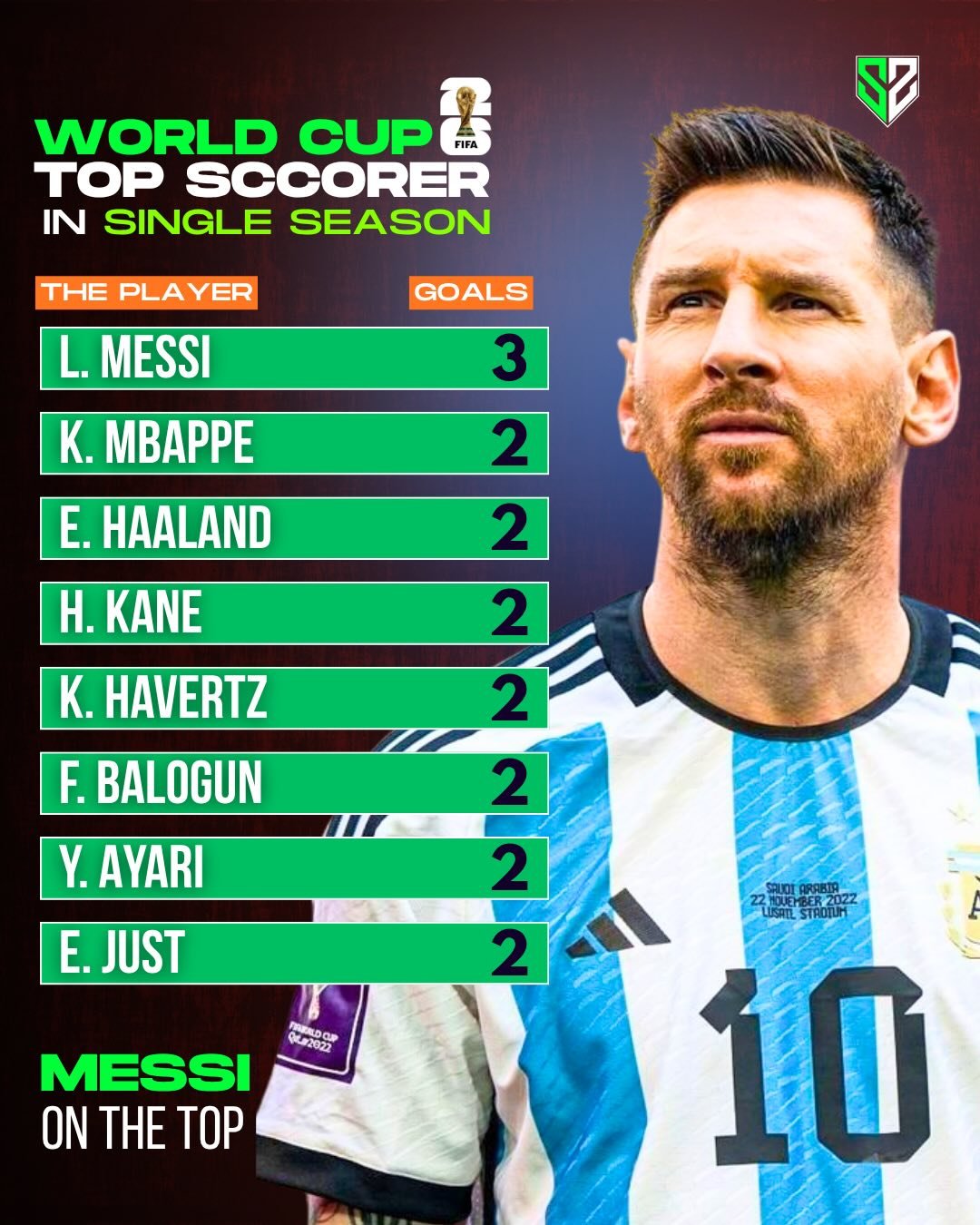
- Joint leaders (3 goals): Jonathan David (Canada), Lionel Messi (Argentina)
- Chasing pack (2 goals): Kylian Mbappé (France), Erling Haaland (Norway), Harry Kane (England), Folarin Balogun (USA), Kai Havertz (Germany), and several others
- Award: The adidas Golden Boot, given to the tournament's top scorer from the group stage through the final
- Tiebreaker rules: Fewest matches played, then most assists, then fewest minutes played — if all are level, the award is shared
How David and Messi Seized the Lead
Jonathan David announced himself as a genuine Golden Boot contender with a sensational hat-trick in Canada's historic 6-0 demolition of Qatar, a result that also delivered the co-hosts their first-ever World Cup win.
Lionel Messi matched him goal-for-goal on the very same day, scoring a hat-trick of his own as Argentina cruised to a 3-0 win over Algeria. The treble did double duty for the Argentine superstar — it also moved him level with Germany's Miroslav Klose atop the all-time World Cup career goal-scoring charts, a record that has stood for over a decade.
The Chasing Pack Is Stacked
Just one goal back, a who's-who of elite finishers are lining up to pounce on any slip-up at the top:
- Kylian Mbappé has two goals so far, including a brilliant long-range stoppage-time strike that sealed France's 3-1 win over Senegal — a goal that also pushed him past Olivier Giroud as France's all-time leading international goalscorer.
- Erling Haaland marked his long-awaited World Cup debut in style, scoring twice as Norway routed Iraq 4-1 in their first World Cup appearance in 28 years.
- Harry Kane bagged a brace — a penalty and a header — in a win over Croatia, moving level with Gary Lineker as England's all-time leading World Cup scorer.
Beyond that trio, the FIFA Golden Boot tracker lists a total of nine players already on two goals apiece, underlining just how open the race remains this early in the tournament.
Why This Golden Boot Race Looks Wide Open
A few factors are stacking the deck for a genuinely unpredictable finish:
- The expanded 48-team format means more group-stage matches and more opportunities for the chasing pack to close the gap before the knockout rounds even begin.
- Proven big-game scorers like Cristiano Ronaldo, Vinícius Júnior, Ousmane Dembélé, and rising star Lamine Yamal are all lurking just outside the headline standings, capable of surging up the table in a single match.
- The strict tiebreaker system means efficiency matters as much as raw goal count — a player who reaches the same tally in fewer minutes, fewer matches, or with more assists could leapfrog the field without scoring another goal.
What It Would Take to Win It All
History suggests there's still a long way to go. Just Fontaine's legendary 13-goal haul at the 1958 World Cup remains the all-time record for goals scored in a single tournament, untouched 68 years later. More recently, Mbappé needed 8 goals in 7 matches to claim the 2022 Golden Boot, edging out Messi in a finish that went down to the wire. With both David and Messi sitting on 3 goals already — and a long road still ahead through the group stage and knockouts — this year's race has every chance of producing a similarly dramatic conclusion.
Final Thoughts
Two hat-tricks in one week have set an electric tone for the 2026 Golden Boot race, but with Mbappé, Haaland, Kane, and a deep pool of elite finishers still to come, nothing is settled. If the opening week is anything to go by, this year's chase for the top scorer crown could run all the way to the final on July 19.
The "Social-First" World Cup: How Gen Z and Experiential Tourism are Rewriting the Sports Playbook

The global sports landscape is undergoing a seismic, structural shift. For decades, the formula for consuming major sporting events like the FIFA World Cup was simple: fans gathered around a television set, tuned into a traditional linear broadcast, and watched a 90-minute match from kickoff to the final whistle.
Today, that playbook is obsolete.
As we approach the historic, tri-nation tournament hosted across the United States, Canada, and Mexico, a dual revolution is taking place. Off the pitch, the way fans engage with the beautiful game has fundamentally shifted. Analysts are tracking a massive trend toward "social-first" viewing, dominated by a younger demographic—particularly Gen Z—who favor short-form highlights, TikTok commentary, and instant reaction clips over traditional long-form broadcasts.
Simultaneously, this digital transformation is mirrored by a physical one. The vast, multi-country format of the upcoming tournament has sparked an unprecedented boom in experiential sports tourism. Modern fans are no longer just flying in for a single match; they are turning their tournament tickets into extended, cross-border vacations.
Here is a deep dive into how these two powerful forces are reshaping global sports culture, media consumption, and the travel industry.
1. The Death of the 90-Minute Broadcast? Understanding "Social-First" Viewing
To understand the modern sports fan, one must understand how they interact with media. For Gen Z and younger Millennials, the television is no longer the primary screen; it is often the background noise. The real action happens on the phone.
Traditional Viewing (Linear TV) ──► 90-Minute Live Match ──► Passive Consumption
Social-First Viewing (Multi-Screen) ──► Memes, TikToks, Shorts ──► Active Engagement
The Rise of Short-Form Content and Snackable Highlights
The modern attention span has been recalibrated by platforms like TikTok, YouTube Shorts, and Instagram Reels. Rather than committing to a full 90-minute match, which can often feature long stretches of defensive play, younger fans prefer snackable content.
- Real-Time Highlights: Fans expect to see a spectacular goal or a controversial red card on their social feeds within seconds of it happening on the pitch.
- Curated Feeds: Algorithmic curation allows fans to consume only the most high-octane moments of a match, bypassed of any downtime.
- User-Generated Content (UGC): Fan-cam footage from the stands often outperforms official broadcast angles because it captures the raw, authentic emotion of the stadium.
The Power of Reaction Clips and Influencer Commentary
For the social-first viewer, the game itself is only half the story. The narrative surrounding the game—the drama, the memes, the tactical breakdowns by independent creators—is arguably more important.
Traditional sports commentators are increasingly being bypassed in favor of platform-native creators. A Gen Z fan is far more likely to get their post-match analysis from a 60-second TikTok creator who uses humor, fast cuts, and trending audio than from a panel of former players in a television studio. This shift has democratized sports media, turning every fan with a smartphone into a potential broadcaster.
2. The Second-Screen Phenomenon and Memetic Culture
The concept of the "second screen" is not entirely new, but its integration into the fan experience has reached a state of maturity. During a live match, a fan's mobile device is not a distraction from the game; it is an enhancement tool.
Real-Time Community and the Global Digital Stadium
When a major event occurs on the pitch—such as a shocking upset or a VAR controversy—the conversation immediately migrates to platforms like X (formerly Twitter), Reddit, and Discord. This creates a virtual, global stadium where millions of fans can collectively react in real-time.
- Memetic Culture: Football has become a highly memetic sport. A single funny face made by a manager on the touchline or an awkward miss by a striker can instantly become a viral meme template. This shared cultural currency binds fans together across geographical boundaries.
- Interactive Gamification: Live-polling, real-time fantasy sports updates, and instant-prediction apps keep viewers actively engaged, transforming them from passive observers into active participants.
3. The Tri-Nation Format and the Boom of Experiential Sports Tourism
While the digital landscape is fragmenting how fans watch the game, the physical landscape of the upcoming World Cup is redefining how they travel. Hosted across three massive nations—the United States, Canada, and Mexico—the tournament is the catalyst for a major surge in experiential sports tourism.
[Canada: Vancouver/Toronto] ──► [USA: 11 Host Cities] ──► [Mexico: CDMX/Monterrey/Guadalajara]
│
▼
Extended "Bleisure" Vacations
From Match-Goers to Cultural Explorers
Historically, sports tourism was transactional: fans flew in, watched their team play, and flew out. Today, sports travel is highly experiential. Because the host cities are spread across different climates, cultures, and time zones, fans are seizing the opportunity to plan extended multi-destination vacations.
- The "Bleisure" Trend: Many fans are blending remote work with leisure travel, allowing them to stay in host regions for weeks at a time.
- Cross-Border Itineraries: A fan might start their journey enjoying the culinary scene in Mexico City, fly to Los Angeles for a group stage match, and conclude their trip hiking in the Pacific Northwest near Vancouver.
The Economic Impact of the Experiential Fan
This shift toward experiential travel is a massive boon for local economies. Modern sports tourists are prioritizing high-value experiences over budget accommodations. They are seeking out:
- Local Gastronomy: Exploring the culinary identity of each host city.
- Ecotourism and Adventure: Combining match days with national park visits, beach excursions, and cultural heritage tours.
- Bespoke Fan Zones: Immersive, localized fan festivals that offer more than just a big screen, featuring live music, local art, and interactive technology.
4. How Brands, Broadcasters, and Marketers Must Adapt
The intersection of social-first viewing and experiential sports tourism represents a paradigm shift. To remain relevant, brands, broadcasters, and marketers must throw out the old playbook and design strategies tailored to this new breed of fan.
| Challenge for Legacy Brands |
Modern Solution for Success |
| Declining Linear TV Ratings |
Co-streaming with popular influencers and creators. |
| Passive Sponsorship Banners |
Interactive, localized AR experiences in host cities. |
| One-Size-Fits-All Content |
Hyper-segmented, platform-specific short-form video. |
| Basic Travel Packages |
Curated, cultural itineraries combining sports and tourism. |
1. Prioritize "Snackable" and Platform-Native Content
Broadcasters can no longer rely solely on the live feed to drive revenue. They must partner with social platforms to deliver near-instantaneous highlights optimized for vertical viewing. Brands should sponsor these bite-sized moments, ensuring high visibility among audiences who may never tune into the live broadcast.
2. Leverage Influencer and Creator Partnerships
To capture the attention of Gen Z, brands must work with creators who already hold the trust of these communities. Whether it’s a travel vlogger documenting the journey between host cities or a tactical analyst breaking down plays on TikTok, creator-led campaigns offer authenticity that traditional advertising simply cannot match.
3. Design Seamless, Multi-Channel Experiences
The physical and digital worlds must merge. For example, tourism boards in the US, Canada, and Mexico can use augmented reality (AR) filters on Instagram and Snapchat to guide fans through host cities, offering digital rewards, discounts at local businesses, or exclusive content when they visit specific physical landmarks.
Conclusion: The Future of Global Sports Fandom
The upcoming tri-nation World Cup is more than just a tournament; it is a preview of the future of global entertainment. The "social-first" viewing revolution has democratized sports media, turning fandom into an active, highly personalized, and community-driven digital experience. At the same time, the physical reality of a multi-host tournament has transformed sports fans into global explorers, driving an unprecedented boom in experiential sports tourism.
For sports organizations, media companies, and travel brands, the message is clear: the modern fan does not want to sit on the sidelines. They want to participate, co-create, explore, and share. Those who understand this dual digital and physical revolution will win the hearts—and the screens—of the next generation of fans.
BLOGS ABOUT GTA VI
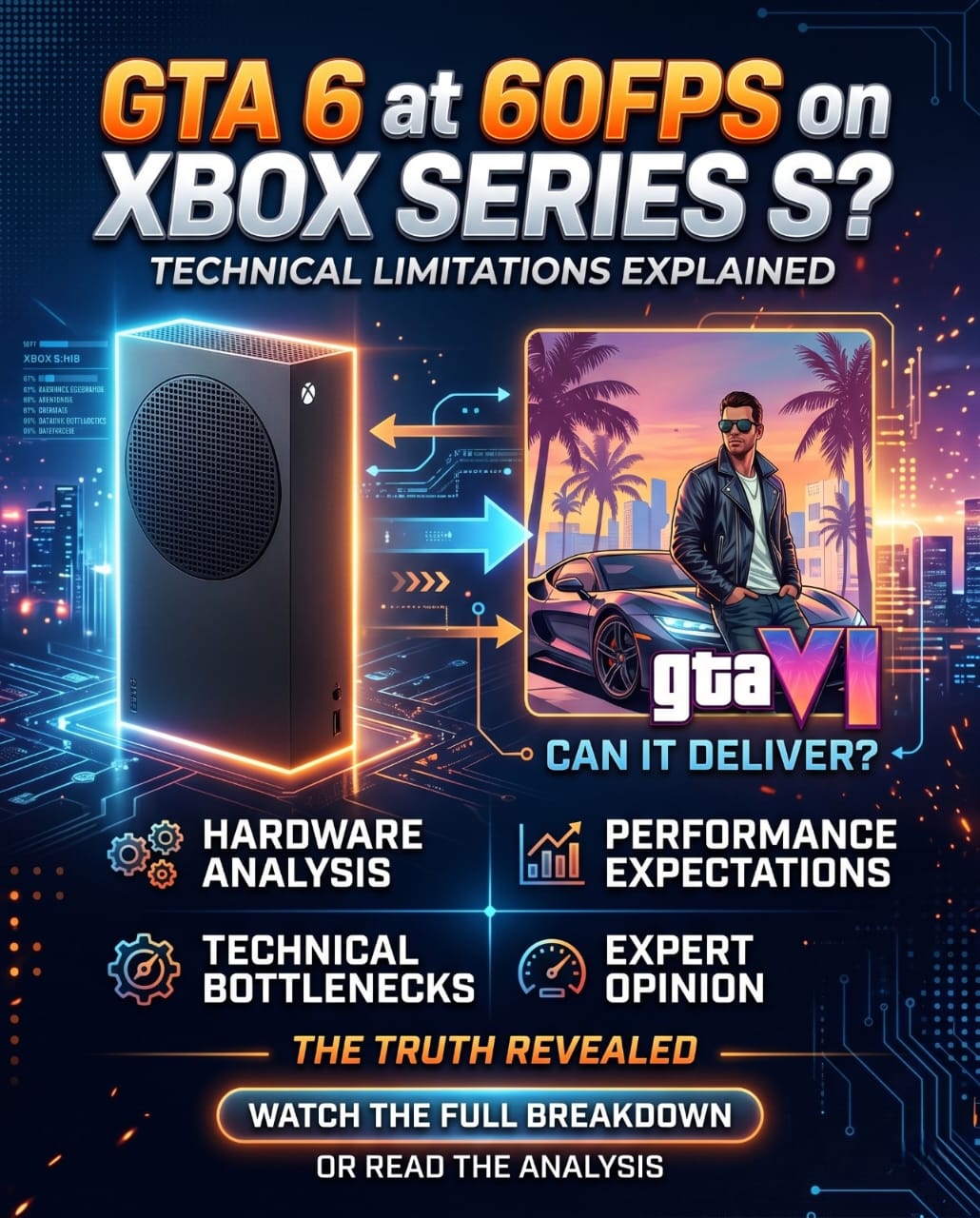
Will GTA 6 Run at 60FPS on Xbox Series S? Technical Limitations Explained
The debut trailer for Grand Theft Auto VI (GTA 6) sent shockwaves through the gaming industry. Showcasing unprecedented crowd density, jaw-dropping lighting, hyper-realistic physics, and a living, breathing rendition of Leonida, Rockstar Games has once again set a new benchmark for what "next-gen" truly means.
However, as the initial hype settles, a looming technical question dominates forums, Reddit threads, and social media: Will GTA 6 run at 60FPS on the Xbox Series S?
The Xbox Series S has been a massive commercial success for Microsoft, offering an affordable entry point into current-gen gaming. But as we move deeper into the generation, the console's modest hardware specifications are being pushed to their absolute limits.
In this deep-dive technical analysis, we will break down the hardware capabilities of the Xbox Series S, analyze the demands of Rockstar’s upgraded RAGE engine, and provide a definitive, realistic expectation of how GTA 6 will perform on Microsoft’s budget console.
The Tale of Two Consoles: Xbox Series X vs. Xbox Series S
To understand the hurdles the Xbox Series S faces, we must first compare its internal hardware to its more powerful sibling, the Xbox Series X. While Microsoft marketed both consoles as sharing the same core architecture, the real-world performance gap is substantial.
| Hardware Component |
Xbox Series X |
Xbox Series S |
The Impact on GTA 6 |
| CPU |
8-Core Zen 2 @ 3.8 GHz |
8-Core Zen 2 @ 3.6 GHz |
Minor performance delta; both CPUs are highly capable. |
| GPU Power |
12 TFLOPs (52 CUs @ 1.825 GHz) |
4 TFLOPs (20 CUs @ 1.565 GHz) |
Massive gap in rendering resolution, ray-tracing, and visual fidelity. |
| System Memory |
16 GB GDDR6 (10GB @ 560GB/s, 6GB @ 336GB/s) |
10 GB GDDR6 (8GB @ 224GB/s, 2GB @ 56GB/s) |
The primary bottleneck. Severe limitations on asset streaming and memory allocation. |
| Target Resolution |
4K (2160p) |
1080p - 1440p |
Series S often drops to 900p or lower in modern titles. |
While the CPU speeds are relatively close, the massive disparities in GPU compute power and memory bandwidth are where the Xbox Series S begins to struggle with demanding, modern AAA titles.
The Technical Bottlenecks of the Xbox Series S
To determine whether a stable 60 frames per second (FPS) is achievable for GTA 6 on the Series S, we have to look at the three major technical pillars of game development: CPU processing, GPU rendering, and memory allocation.
1. The CPU Hurdle: Simulation and World Density
In game development, the graphics card (GPU) dictates how pretty a game looks, but the processor (CPU) dictates how the game runs at a fundamental level. The CPU handles:
- Artificial Intelligence (AI): Pedestrian behavior, traffic patterns, and police responses.
- Physics Calculations: Car crashes, water simulation, wind effects, and ragdoll mechanics.
- Game Logic and Scripting: Keeping track of missions, world events, and player inputs.
Historically, Rockstar Games are incredibly CPU-intensive. The GTA 6 trailer showcased unprecedented levels of simulation complexity—hundreds of NPCs on beaches, dense highway traffic, and complex wildlife behaviors.
Because the Xbox Series S features a Zen 2 CPU that is clocked only slightly lower than the Series X, some argue it should handle the simulation just fine. However, running a simulation of this scale at 60FPS requires double the CPU processing budget of running it at 30FPS. If the CPU is choked trying to calculate the AI of 100 pedestrians on a Vice City street, lowering the resolution to 720p won't help. The CPU simply cannot feed the GPU fast enough to hit 60FPS.
2. The Memory Bottleneck: The 10GB RAM Problem
If there is one aspect of the Xbox Series S hardware that keeps developers awake at night, it is the system memory (RAM).
The Xbox Series S features 10GB of shared GDDR6 memory. However, only 8GB of this memory is high-speed (224GB/s), while the remaining 2GB runs at a sluggish 56GB/s. Furthermore, the console's operating system reserves roughly 2GB to 2.5GB of RAM just to keep the dashboard and system features running. This leaves developers with only 7.5GB to 8GB of usable memory for the entire game.
For a massive, seamless open-world game like GTA 6, memory is everything. The game must constantly stream high-resolution textures, audio files, 3D models, and world data from the SSD into the RAM as the player speeds through the streets. With such a limited memory pool, Rockstar will have to aggressively scale back:
- Texture Quality: To prevent the game from crashing due to "out of memory" errors.
- Asset Streaming Distance: Leading to noticeable pop-in of buildings, trees, and vehicles.
- LOD (Level of Detail) Transitions: Objects in the distance will look significantly less detailed.
This severe memory bottleneck makes optimizing GTA 6 for the Series S an uphill battle, and allocating system memory for a 60FPS performance mode might simply be impossible.
3. The GPU and Resolution Scaling
With only 4 Teraflops of graphical power, the Xbox Series S is roughly equivalent to a mid-range PC graphics card from several years ago.
To run modern games at 60FPS, developers on the Series S frequently rely on aggressive Dynamic Resolution Scaling (DRS) and upscaling technologies like AMD FSR (FidelityFX Super Resolution). We have already seen current-gen titles like Alan Wake 2 and Immortals of Aveum drop to internal rendering resolutions as low as 720p or even 540p on the Series S to maintain a stable frame rate.
If GTA 6 were to offer a 60FPS mode on the Series S, the image quality would likely degrade to a blurry, pixelated mess, undermining the visual achievements of the RAGE engine.
Rockstar’s RAGE Engine and Next-Gen Ambitions
Rockstar Games does not make compromises when it comes to visual fidelity. They build their games on the proprietary Rockstar Advanced Game Engine (RAGE), which has been heavily upgraded for GTA 6 (RAGE 9).
RAGE 9 is expected to feature:
- Real-Time Ray-Traced Global Illumination and Reflections: Making the neon lights of Vice City look incredibly lifelike.
- Advanced Volumetric Rendering: Realistic fog, clouds, smoke, and weather effects.
- Physically-Based Rendering (PBR) Materials: Ensuring that leather, metal, sand, and water react naturally to light.
While the Xbox Series X and PS5 will have the hardware headroom to handle these advanced rendering techniques (likely at 30FPS with dynamic 4K), the Xbox Series S will have to disable many of these features entirely. Attempting to run these engine-level upgrades at 60FPS on a 4 TFLOP GPU is, realistically, out of the question.
The Historical Context: How Has Rockstar Handled Frame Rates?
To predict the future, we must look at the past. Rockstar Games has a long-standing history of prioritizing visual density, cinematic presentation, and rock-solid stability over high frame rates at launch.
- Grand Theft Auto V (2013): Launched on Xbox 360 and PS3 at a locked 30FPS (which frequently dipped into the low 20s).
- Red Dead Redemption 2 (2018): Launched on Xbox One and PS4 at a locked 30FPS. Even on the mid-gen upgrades (Xbox One X and PS4 Pro), Rockstar chose to push image quality and native 4K resolution rather than offering a 60FPS mode.
- GTA V Next-Gen Re-release (2022): It took a dedicated remaster on PS5 and Xbox Series X/S for players to finally experience GTA V at a native 60FPS on consoles.
Rockstar's philosophy has always been to deliver a jaw-dropping, cinematic experience first. It is highly probable that GTA 6 will target a locked 30FPS across all consoles at launch, including the PlayStation 5 and Xbox Series X. If the premium consoles are targeting 30FPS, the Xbox Series S running at 60FPS is mathematically impossible.
What Will GTA 6 Actually Look Like on Xbox Series S?
While a 60FPS mode is highly unlikely, Xbox Series S owners should not despair. Rockstar Games employs some of the best optimization engineers in the world. When Red Dead Redemption 2 launched on the base Xbox One (a console with a notoriously weak CPU and slow DDR3 RAM), it still looked and played phenomenally well.
Here is what we can realistically expect from GTA 6 on the Xbox Series S:
- Target Frame Rate: A locked, highly stable 30FPS. Rockstar will prioritize frame pacing to ensure the 30FPS feels smooth and responsive.
- Target Resolution: A dynamic resolution targeting 900p to 1080p, which will upscale to 1440p using AMD FSR 3.
- Visual Compromises:
- Reduced pedestrian and vehicle density compared to the Series X.
- Simplified lighting models (no ray-tracing).
- Lower resolution textures and shadows.
- Slightly shorter draw distances.
Despite these compromises, the game will still look spectacular. The core gameplay loop, the gripping narrative, the map size, and the physics engine will remain completely intact.
Conclusion: The Definitive Verdict
So, will GTA 6 run at 60FPS on the Xbox Series S?
The definitive answer is no.
The combination of a highly demanding, CPU-intensive simulation, a severe system memory bandwidth bottleneck, and a GPU power gap makes 60FPS an unrealistic target for the Xbox Series S.
However, this is not a failure of the console, nor is it a failure of Rockstar's development team. It is simply the reality of pushing the boundaries of interactive entertainment. When GTA 6 launches, it will be designed to showcase the absolute pinnacle of gaming technology.
For Xbox Series S players, the reward will not be a high frame rate, but rather the technical miracle of playing the most advanced open-world game ever created on a budget-friendly console. If 60FPS is an absolute must-have for your gaming experience, it may be time to start saving for an Xbox Series X, a PlayStation 5, or a high-end gaming PC.
Why GTA 6 is Skipping PS4, Xbox One, and PC (At Launch) – The Technical & Business Truth
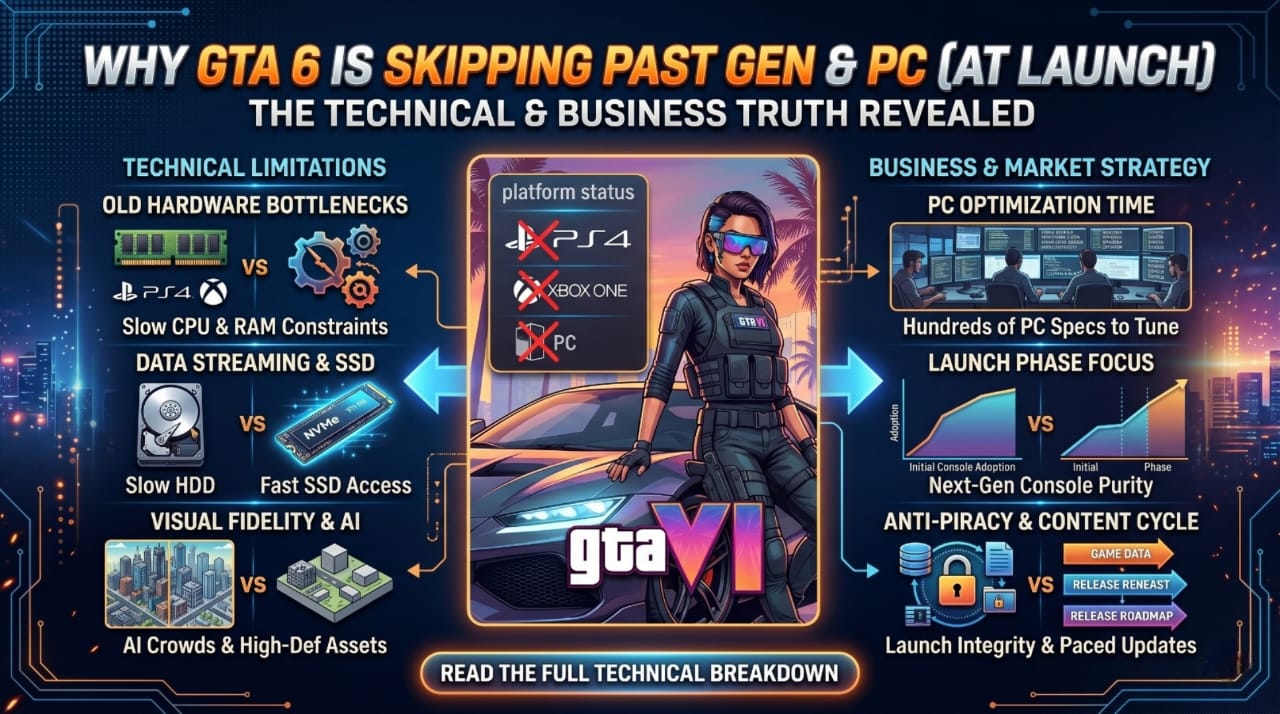
The debut trailer for Grand Theft Auto VI (GTA 6) didn't just break the internet; it shattered the expectations of millions of gamers worldwide. While the breathtaking visuals of a neon-drenched Leonida left fans in awe, the closing slate of the trailer delivered a sobering reality check: GTA 6 is coming in Fall 2025, but only to PlayStation 5 and Xbox Series X|S.
Conspicuously absent from this list were the PlayStation 4, Xbox One, and—much to the dismay of the master race—the PC.
To the casual observer, ignoring the massive install bases of last-gen consoles and the lucrative PC gaming market seems like a massive financial oversight. However, as an elite industry analyst, I can tell you this is a calculated, brilliant move.
Below, we strip away the marketing hype to expose the technical bottlenecks and ruthless business strategies that forced Rockstar Games and its parent company, Take-Two Interactive, to leave the PS4, Xbox One, and PC behind at launch.
1. The Technical Reality: Why Last-Gen Consoles Can’t Handle Vice City 2.0
To understand why eighth-generation consoles (PS4 and Xbox One) were left on the cutting room floor, we must look at the hardware. These consoles were released in 2013. By the time GTA 6 launches in late 2025, they will be twelve-year-old pieces of hardware.
Trying to run GTA 6 on a PS4 would be like trying to run Cyberpunk 2077 on a Nintendo DS. It is a technical impossibility due to three major hardware bottlenecks:
The CPU Bottleneck (The AMD Jaguar Problem)
The single biggest limiting factor of the PS4 and Xbox One is their central processing unit (CPU). Both consoles utilize a highly customized, low-power AMD Jaguar CPU architecture designed originally for netbooks.
- Why this matters for GTA 6: Grand Theft Auto games are not just about rendering pretty graphics; they are complex, living simulations. The CPU handles non-player character (NPC) artificial intelligence, traffic density, physics calculations, collision detection, and dynamic weather systems.
- The Verdict: The Jaguar CPU simply cannot process the sheer volume of calculations required to simulate GTA 6's rumored crowd density, advanced AI routines, and highly interactive environments. If Rockstar attempted to scale the game down to these CPUs, it would require stripping away the very features that make it a next-generation experience.
The Storage Bottleneck (Mechanical HDDs vs. NVMe SSDs)
The PS5 and Xbox Series X|S are built around ultra-fast, proprietary NVMe Solid-State Drives (SSDs). The PS4 and Xbox One rely on ancient, mechanical 5400 RPM Hard Disk Drives (HDDs).
- Asset Streaming: In a massive open-world game, the engine must constantly load and unload assets (textures, models, audio) as the player moves through the world.
- The Speed Gap: The PS5's SSD can stream data at raw speeds of up to 5.5 GB/s. In contrast, the PS4's HDD struggles to hit 100 MB/s.
- The Verdict: If you drove a supercar down a high-speed highway in GTA 6 on a PS4, the game engine would not be able to load the world fast enough. You would constantly crash into invisible walls, experience massive texture pop-in, and face frequent loading screens.
Memory Bandwidth and Capacity
The PS4 and Xbox One feature 8GB of shared system memory (RAM). However, a significant portion of this is reserved for the console’s operating system, leaving developers with roughly 5GB to 6GB of usable memory.
The PS5 and Xbox Series X boast 16GB of high-speed GDDR6 RAM. This massive jump in capacity and bandwidth allows the engine to keep higher-resolution textures, complex geometry, and vast amounts of gameplay data in memory simultaneously. Without this, the visual fidelity showcased in the GTA 6 trailer would be impossible to achieve.
2. The PC Launch Delay: The Technical and Optimization Puzzle
While the exclusion of last-gen consoles makes sense from a hardware perspective, the omission of a day-one PC release left many PC enthusiasts furious. Why would Rockstar skip the platform that has kept GTA Online alive and incredibly profitable for over a decade? The answer lies in the complexity of game development and PC hardware fragmentation.
+-------------------------------------------------------------+
| THE DEVELOPMENT TIMELINE GAP                                |
+-------------------------------------------------------------+
|                                                             |
| [Phase 1] Console Optimization (PS5 / Xbox Series X|S)      |
| - Fixed hardware configurations (only 2 targets)            |
| - Direct access to system APIs                              |
|                                                             |
| [Phase 2] PC Porting & Optimization (Post-Launch)           |
| - Testing thousands of CPU/GPU combinations                 |
| - Anti-cheat integration & DRM security setup               |
|                                                             |
+-------------------------------------------------------------+
The Nightmare of Hardware Fragmentation
When developing for consoles, Rockstar only has to optimize the game for two target profiles: the PlayStation 5 and the Xbox Series X|S (with the Series S presenting its own optimization challenges).
The PC ecosystem, however, is highly fragmented:
- Thousands of Combinations: There are millions of active PC configurations, combining CPUs from Intel and AMD, GPUs from NVIDIA, AMD, and Intel, different RAM speeds, various motherboard chipsets, and different storage drives.
- Optimization Bottlenecks: Ensuring a game as massive as GTA 6 runs stably across all these configurations without crashing, stuttering, or breaking requires an immense amount of QA (Quality Assurance) testing and fine-tuning.
- The Verdict: By delaying the PC version, Rockstar can focus 100% of its resources on delivering a polished console release first, avoiding the disastrous, buggy PC launches that have plagued other major publishers in recent years (e.g., The Last of Us Part I or Star Wars Jedi: Survivor).
Rockstar’s Historical Playbook
Skipping PC at launch is not a new strategy for Rockstar Games; it is their standard operating procedure.
- Grand Theft Auto IV: Released on consoles in April 2008; arrived on PC in December 2008 (8-month delay).
- Grand Theft Auto V: Released on PS3/Xbox 360 in September 2013; arrived on PC in April 2015 (19-month delay).
- Red Dead Redemption 2: Released on consoles in October 2018; arrived on PC in November 2019 (13-month delay).
Rockstar has a proven track record of using the console release as a foundation, then spending an extra year or more optimizing and enhancing the engine to push the boundaries of high-end PC hardware.
3. The Business Truth: Rockstar & Take-Two’s Financial Masterclass
While technical limitations are a convenient truth, the decisions made by Rockstar and Take-Two Interactive are ultimately driven by the bottom line. The launch strategy of GTA 6 is designed to maximize revenue in ways that only a franchise of this magnitude can pull off.
The Art of "Double-Dipping"
"Double-dipping" is the consumer behavior where a player purchases the exact same game multiple times on different platforms. Rockstar Games has turned this into an art form.
When GTA 5 launched in 2013, millions of players bought it on PS3 or Xbox 360. When the remastered version launched in 2014 for PS4 and Xbox One, those same players bought it again for the upgraded visuals. When the PC version launched in 2015, they bought it a third time for mods and 60 FPS gameplay.
By staggering the release of GTA 6, Take-Two Interactive is setting up a highly predictable, incredibly lucrative revenue cycle:
- 2025: Millions of players purchase GTA 6 on PS5 and Xbox Series X|S.
- 2026/2027: Rockstar releases the highly anticipated PC version with upgraded graphics, ray-tracing, and mod support. A massive percentage of the console player base will buy the game a second time to experience it on their high-end PC rigs.
Combating Piracy and Protecting Early Sales
The first few weeks of a game's launch are the most critical for revenue generation. On consoles, piracy is virtually non-existent due to closed ecosystems and digital rights management (DRM) systems.
On PC, despite advanced DRM systems like Denuvo, games are highly susceptible to being cracked and pirated shortly after release. By launching exclusively on consoles, Rockstar ensures that 100% of early adopters must purchase a legitimate copy of the game, securing billions of dollars in day-one revenue without the risk of piracy eating into their margins.
Platform Holder Incentives and Console Sales
It is highly likely that Sony and Microsoft are actively negotiating behind the scenes—or have already secured—co-marketing rights for GTA 6.
- System Sellers: GTA 6 is the ultimate "system seller." There are still tens of millions of gamers playing GTA Online on PS4 and Xbox One who have not yet upgraded to current-gen consoles.
- The Hardware Push: By making GTA 6 exclusive to PS5 and Xbox Series X|S, Rockstar is single-handedly giving these players the ultimate reason to finally buy a new console. Sony and Microsoft will undoubtedly leverage this with hardware bundles, driving massive console sales in late 2025.
Summary: A Necessary Sacrifice for a True Generational Leap
While it is frustrating for PC players and those who haven't upgraded their consoles yet, skipping the PS4, Xbox One, and PC at launch is the best decision Rockstar could have made for the health of the game.
By leaving last-gen consoles behind, Rockstar’s developers are not held back by the weak CPUs and slow hard drives of 2013. They can fully utilize the power of modern SSDs, ray-tracing hardware, and advanced multi-threaded CPUs to build a world that feels truly next-gen. And by delaying the PC version, they protect their initial sales from piracy while ensuring that when the PC version does arrive, it will be the definitive, highly optimized masterpiece that PC gamers deserve.
GTA 6 is not just a game; it is an industry-defining event. When Fall 2025 arrives, the gaming landscape will change forever—and it will be powered entirely by the cutting edge of technology.
What Do You Think?
Are you planning to upgrade to a PS5 or Xbox Series X|S just to play GTA 6 at launch, or will you hold out for the eventual PC release? Let us know in the comments below!
The Ultimate Gamble: Why Rockstar Games is Totally Dependent on the Success of GTA VI

There is no franchise in the history of entertainment quite like Grand Theft Auto.
When Rockstar Games released Grand Theft Auto V in 2013, they didn’t just launch a video game; they unleashed a cultural and economic juggernaut. Generating over $1 billion in its first three days and selling over 190 million copies to date, GTA V is officially the most financially successful media product of all time.
But this unprecedented success has created a double-edged sword. As we edge closer to the highly anticipated release of Grand Theft Auto VI (GTA VI), the stakes have never been higher.
Rockstar Games is no longer just a game developer; it is an empire built entirely on the foundation of a single franchise. Today, the studio finds itself in a position of total dependency on the success of GTA VI. If it succeeds, Rockstar secures another decade of cultural dominance. If it falters, the ripple effects could devastate not just the studio, but its parent company, Take-Two Interactive, and the broader gaming industry.
Here is a deep dive into why Rockstar Games has backed itself into a corner, and why GTA VI is the ultimate make-or-break moment for the legendary studio.
1. The Billion-Dollar Shadow of GTA V and GTA Online
To understand why Rockstar is so dependent on GTA VI, we must first look at the towering shadow cast by its predecessor.
For over a decade, GTA Online—the multiplayer component of GTA V—has served as Rockstar’s primary financial engine. Through the sale of "Shark Cards" (in-game currency) and the implementation of the GTA+ subscription service, Rockstar created a recurring revenue stream that defied the traditional lifecycle of video games.
This financial cushion allowed Rockstar to take their time. They stopped releasing multiple games per year, a stark contrast to the PlayStation 2 era when they launched GTA III, Vice City, and San Andreas within a four-year span. Instead, they poured all their resources into singular, massive projects.
However, this strategy has created several critical vulnerabilities:
- The "One-Basket" Egg Strategy: Rockstar has put almost all its financial eggs into the GTA basket. Aside from Red Dead Redemption 2 in 2018, the studio has released no other major new titles in over ten years.
- Unprecedented Expectations: Players have spent a decade playing a highly polished, constantly updated game. GTA VI does not just have to be better than GTA V was at launch; it has to be better than what GTA V became after ten years of continuous updates.
- The Fatigue of the Current Model: While GTA Online still generates massive revenue, active player counts and microtransaction sales are naturally beginning to plateau. The market is desperate for the next evolution.
2. The Astronomical Costs of Modern AAA Game Development
The gaming industry has shifted dramatically since 2013. Today, AAA game development is more expensive, time-consuming, and risky than ever before.
Industry rumors and financial analyst projections suggest that the total budget for GTA VI—including development, marketing, and long-term infrastructure—could sit anywhere between $1 billion and $2 billion. This would make it, by far, the most expensive video game ever produced.
Estimated GTA VI Budget Breakdown:
├── Core Game Development: $500M - $800M
├── Global Marketing & PR: $300M - $500M
└── Server Infrastructure & Post-Launch Support: $200M+
When a company spends this much money on a single product, the margin for error shrinks to zero.
The Opportunity Cost of a 12-Year Development Cycle
In the time it has taken to develop GTA VI, other major publishers have released entire trilogies. Rockstar’s decision to focus almost exclusively on this one title means they have sacrificed the opportunity to build other revenue-generating franchises.
If GTA VI does not immediately recoup its budget and generate billions in profit within its first fiscal year, Take-Two Interactive will face severe pressure from its shareholders, potentially leading to budget cuts, layoffs, and a forced shift in creative direction.
3. Creative Brain Drain: The Loss of Rockstar’s Founding Fathers
A company is only as good as its talent, and over the last few years, Rockstar Games has suffered a quiet but devastating creative shift. Several of the key architects behind the studio's signature satirical tone, cinematic storytelling, and world-building have departed:
- Dan Houser: Co-founder, head writer, and the creative voice behind GTA, Red Dead Redemption, and Bully. His departure in 2020 sent shockwaves through the industry.
- Leslie Benzies: Former President of Rockstar North and the lead producer/developer who historically "fixed" games when development went off the rails. He left after a highly publicized legal dispute.
- Lazlow Jones: The writer and producer responsible for the iconic in-game radio stations, talk shows, and satirical advertisements that gave the GTA universe its identity.
Without these creative pillars, GTA VI is the first major Rockstar game written and produced by a new guard.
This creates a massive risk. Will the game retain the sharp, counter-culture, politically incorrect satire that defined the franchise? Or will it feel watered down and corporate? If the writing fails to resonate with fans, the critical backlash could severely damage the brand's long-term value.
4. The Live-Service Migration Dilemma
The true financial success of GTA VI does not lie in its initial $70 retail sales. The real battleground is GTA VI Online.
Rockstar’s business model depends on migrating millions of active, paying players from the old GTA Online to the new iteration. This is a highly delicate process.
The Migration Risk:
[Existing GTA Online Player Base]
│
├─► Option A: Stay on GTA V (Keep 10 years of progress, cars, properties)
│
└─► Option B: Move to GTA VI (Start from scratch, spend money again)
If Rockstar makes the transition too aggressive, they risk alienating their loyal player base. If they make it too soft, players will have no incentive to leave their established empires in Los Santos for a fresh start in Vice City.
Furthermore, the live-service gaming market is far more crowded today than it was in 2013. Rockstar is no longer just competing with other open-world games; they are competing for player time against titans like Fortnite, Roblox, Call of Duty: Warzone, and Apex Legends.
5. Take-Two Interactive’s Stock Price and Shareholder Pressure
Rockstar Games is the crown jewel of Take-Two Interactive. When Rockstar succeeds, Take-Two's stock skyrockets. When there is a delay or negative news, billions of dollars in market capitalization vanish overnight.
Take-Two’s financial projections for the upcoming fiscal years are incredibly aggressive. They have projected record-breaking net bookings that can only be achieved by the release and immediate financial success of GTA VI.
- The Stock Market Reality: Wall Street has already priced the success of GTA VI into Take-Two’s stock. If the game is delayed, or if it launches with technical issues (similar to the disastrous launches of Cyberpunk 2077 or Rockstar's own GTA: The Trilogy – The Definitive Edition), the financial fallout will be catastrophic.
- The Demise of Other IPs: Because Take-Two is banking so heavily on Rockstar’s flagship title, other beloved franchises like Mafia, Bioshock, and Max Payne have been sidelined or given significantly smaller budgets. The entire publisher's health is tied to a single launch window.
Conclusion: A High-Stakes Leap into the Future
Rockstar Games has spent the last decade positioning itself as the undisputed king of the gaming industry. But in doing so, they have constructed a golden cage.
By allowing their entire business model to revolve around a single intellectual property, they have eliminated any safety net. GTA VI cannot simply be a great game; it must be a cultural phenomenon, a financial miracle, and a technological masterpiece all at once.
The pressure on the developers at Rockstar North and throughout the global studios is unimaginable. They are fighting to prove that they can still deliver industry-defining experiences without their founding creative minds, while carrying the financial weight of a multi-billion-dollar parent company on their shoulders.
When GTA VI finally launches, the entire entertainment world will be watching. It is the biggest gamble in video game history—and Rockstar has no choice but to win.
Why GTA 6 is the Ultimate Next-Gen Game: 5 Revolutionary Features That Will Redefine Gaming
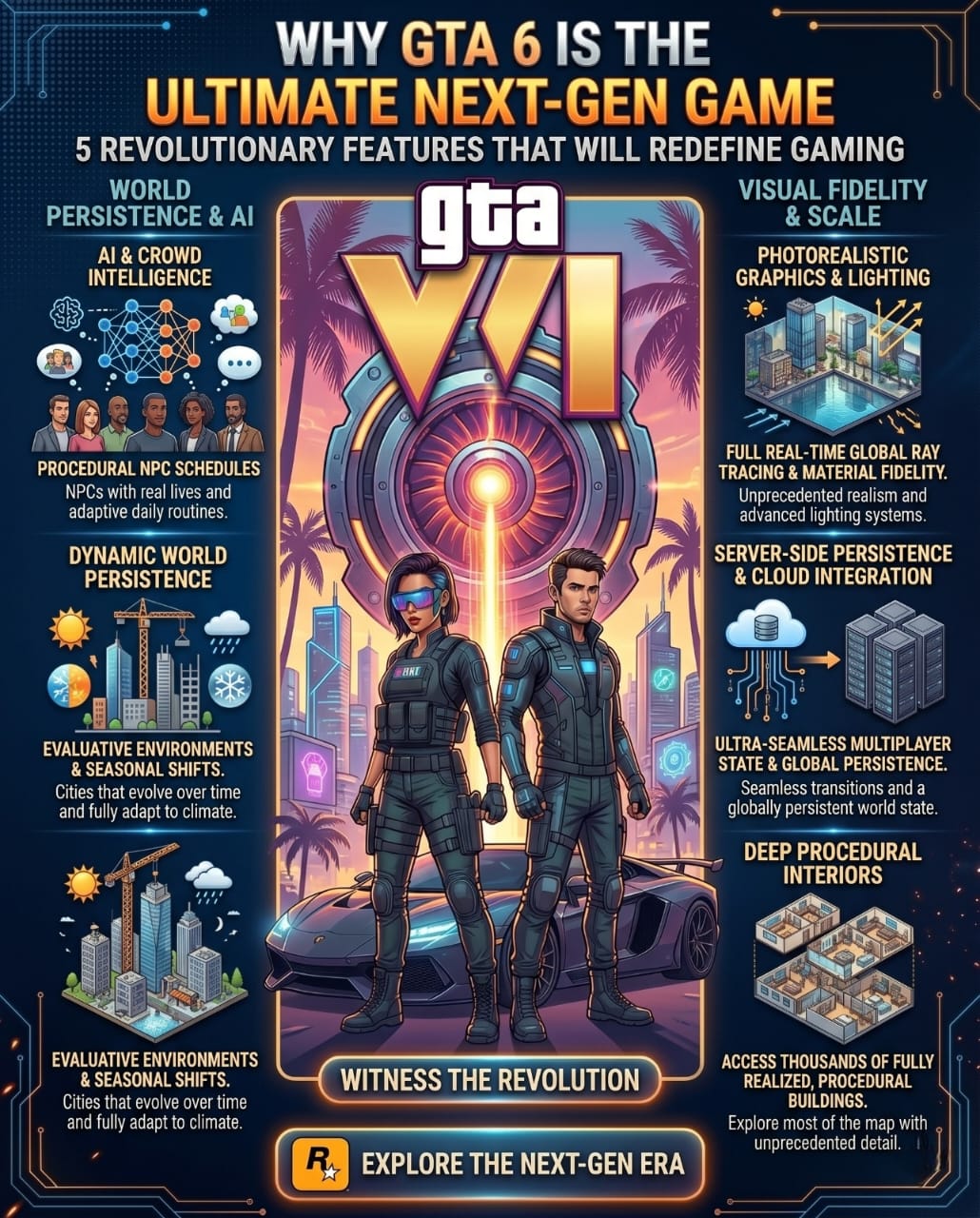
The global gaming community has experienced countless evolutionary steps over the last decade, but few milestones carry the weight of a new release from Rockstar Games. Since the record-breaking launch of Grand Theft Auto V in 2013, the gaming landscape has shifted dramatically. We have transitioned through console generations, witnessed the rise of ray tracing, and seen open-world environments grow to unfathomable scales.
Yet, the anticipation for Grand Theft Auto VI (GTA 6) transcends simple hype. It represents a paradigm shift.
As the first entry in the franchise built from the ground up exclusively for next-generation hardware—specifically the PlayStation 5, Xbox Series X/S, and modern high-end PCs—GTA 6 is poised to set a benchmark that will dictate the trajectory of the gaming industry for the next ten years.
But what exactly makes this title the ultimate next-gen experience? Beyond the stunning visuals of a neon-drenched Vice City and the state of Leonida, Rockstar is implementing ground-up technological innovations. Here are 5 revolutionary features in GTA 6 that are set to redefine open-world game design forever.
1. Groundbreaking NPC Intelligence and Dynamic Crowds
For years, open-world games have suffered from the "background noise" dilemma: cities populated by brainless non-player characters (NPCs) walking in predictable loops, uttering repetitive dialogue, and ignoring the player’s actions until provoked. GTA 6 is set to shatter this illusion of life with a patented, highly advanced NPC behavior and locomotive system.
The Psychology of a Living City
Rockstar Games has developed a proprietary AI system that grants NPCs individual personalities, routines, and memory. Instead of spawning randomly, citizens in the state of Leonida will have:
- Dynamic Daily Routines: NPCs will commute, work, shop, and socialize based on realistic day-night cycles.
- Situational Awareness: Crowds will react organically to weather changes, traffic accidents, and player behavior. If you walk down the street holding a weapon, some NPCs might panic and flee, while others might discreetly call the police or record you on their smartphones.
- Social Group Dynamics: Rather than walking alone, NPCs will interact in groups, engage in conversations, and display complex body language that makes the virtual world feel genuinely inhabited.
This level of detail transforms the game from a static playground into a living, breathing ecosystem where every interaction feels unique and consequential.
2. Next-Generation Physics and Environmental Destruction
While graphics capture our attention in trailers, gameplay physics dictate how immersive a virtual world actually feels to play. Leveraging an upgraded version of the proprietary RAGE (Rockstar Advanced Game Engine), GTA 6 introduces physics calculations that were simply impossible on previous console generations.
Photorealistic Water and Weather Simulation
Set in a fictionalized version of Florida, water and weather play a massive role in the identity of Leonida. Rockstar has dedicated unprecedented resources to perfecting:
- Advanced Hydrodynamics: Water in GTA 6 features real-time wave simulation, wind interaction, and realistic buoyancy. Whether you are jet-skiing through the keys or navigating a swamp in an airboat, the water responds realistically to your vessel.
- Volumetric Weather Systems: Hurricanes, tropical storms, and dense fog will dynamically roll across the map. These weather events aren't just visual filters; high winds will affect vehicle handling, debris will fly across roads, and lightning can strike structures.
Vehicle Deformation and Destruction
Driving has always been a core pillar of the franchise. In GTA 6, vehicle damage is calculated with surgical precision. Car crashes result in realistic metal bending, shattering glass, and peeling paint, with damage directly affecting the mechanical performance of the vehicle.
3. The Evolution of Dual-Protagonist Narrative and Social Media Integration
Storytelling in open-world games often struggles with pacing and player agency. GTA 6 tackles this challenge head-on by introducing a Bonnie-and-Clyde-style dual-protagonist dynamic featuring Lucia and Jason.
[ Lucia ] <====== Dynamic Relationship Mechanics ======> [ Jason ]
   |                                                      |
   +---> Shared Inventories, Co-op Heist Tactics, <-------+
         and Branching Narrative Trust Systems
Seamless Character Swapping and Trust Mechanics
Building upon the character-switching mechanic pioneered in GTA V, GTA 6 refines this system to feel seamless and narratively integrated.
- Contextual Swapping: Switch between Lucia and Jason instantly during high-stakes heists to execute tactical maneuvers from different vantage points.
- The Trust System: Your choices, dialogue options, and actions during missions will influence the relationship and trust level between the two protagonists, opening up unique narrative branches, gameplay perks, or conflicts.
A Satirical, Living Social Media Ecosystem
In today's world, culture is viewed through the lens of a smartphone screen. GTA 6 embraces this reality by integrating an in-game social media engine. Players will see viral videos, live streams, and trending topics that react directly to their criminal exploits. This meta-layer of storytelling satirizes modern influencer culture while making the player feel like their actions have a viral impact on the virtual world.
4. An Ever-Expanding, Seamless Map Design (Leonida)
One of the biggest complaints of modern open-world games is the reliance on loading screens and artificial barriers. GTA 6 addresses this by utilizing the ultra-fast solid-state drives (SSDs) of next-gen hardware to deliver a completely seamless experience across a map of unprecedented scale.
No More Loading Screens
Whether you are entering a high-end nightclub in Vice City, boarding a superyacht, or fast-traveling across the state of Leonida, the game transition is instantaneous. This allows for:
- Unprecedented Interior Density: Unlike previous titles where 90% of buildings were hollow shells, GTA 6 features an incredibly high ratio of enterable buildings—ranging from convenience stores and restaurants to residential apartments and skyscrapers.
- Dynamic Asset Streaming: The game engine streams high-resolution textures and assets in real-time, eliminating pop-in and maintaining a flawless level of detail even when flying at high speeds in a jet.
An Evolving World
Rumors and leaks suggest that Rockstar plans to utilize a modular map design, allowing the state of Leonida to expand and evolve over time via post-launch updates. New cities, islands, and interior spaces will be added seamlessly, keeping the world fresh for years to come.
5. Real-Time Global Illumination and Ray-Traced Audio
To achieve true photorealism, a game must master how light and sound behave in the real world. GTA 6 utilizes cutting-edge hardware-accelerated ray tracing to create a visual and auditory experience that blurs the line between reality and CGI.
| Feature |
Technological Implementation |
Gameplay Impact |
| Real-Time Global Illumination |
Dynamic light bounces calculated per frame. |
Neon lights of Vice City reflect realistically off wet asphalt and metallic car paint. |
| Ray-Traced Audio (Acoustics) |
Sound waves pathfind through environments. |
Gunshots ring differently in an open alleyway versus a cramped concrete parking garage. |
| Dynamic Soft Shadows |
Shadows change sharpness based on light source distance. |
Sunlight filtering through palm trees shifts realistically as the sun sets. |
Conclusion: The Dawn of a New Era in Gaming
Grand Theft Auto VI is not just a sequel; it is a declaration of what is possible when unlimited creative vision meets cutting-edge hardware. By revolutionizing NPC artificial intelligence, pushing the boundaries of physics engines, crafting a deeply personal dual-protagonist narrative, eliminating loading barriers, and mastering photorealistic rendering, Rockstar Games is set to deliver the definitive next-gen masterpiece.
When GTA 6 finally launches, it won't just break sales records—it will rewrite the rulebook for the entire gaming industry, proving once again why Rockstar remains the undisputed king of open-world game design.
The wait has been long, but the revolution is just around the corner. Prepare yourselves: Vice City is calling, and gaming will never be the same.
Best Budget Gaming PC for GTA VI: Play Grand Theft Auto 6 Without Breaking the Bank
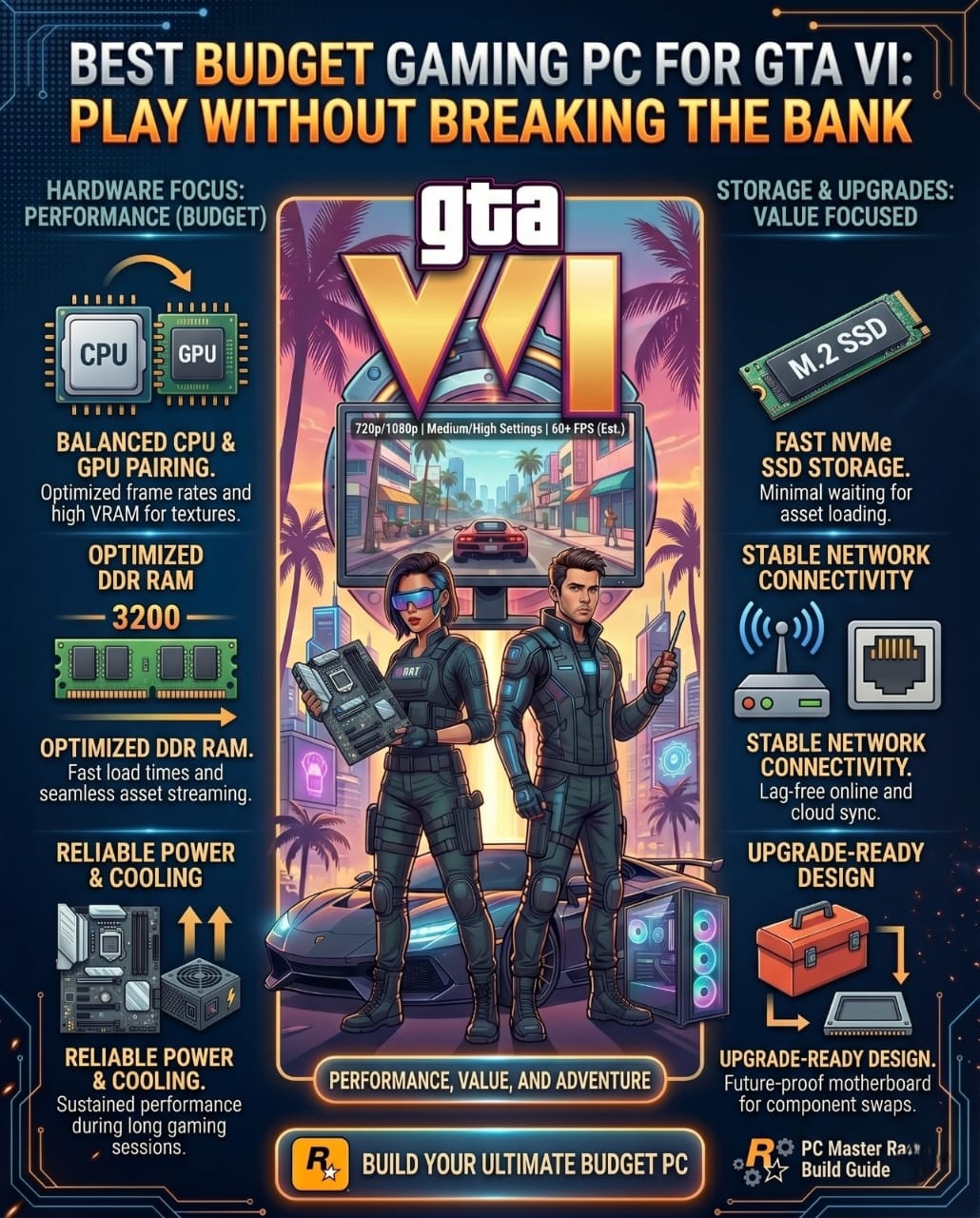
The countdown to Rockstar Games’ next masterpiece has officially begun. Ever since the record-breaking first trailer dropped, gamers worldwide have been asking one critical question: Can my PC run GTA VI?
With its mind-blowing crowd density, hyper-realistic physics, and next-generation lighting systems, Grand Theft Auto 6 is poised to be one of the most demanding video games ever released. If you are gaming on an aging rig, the thought of exploring a neon-soaked, ultra-detailed Vice City might have you worried about your bank account.
But here is the good news: You do not need to spend $3,000 on a liquid-cooled supercomputer to enjoy GTA VI.
By making smart, calculated decisions on your hardware, you can build or buy an affordable, high-performance gaming rig that delivers a smooth, console-crushing experience. In this comprehensive guide, we will break down the expected system requirements, analyze the best budget components, and provide concrete PC builds that will let you experience GTA VI without breaking the bank.
Understanding the Beast: Expected GTA VI System Requirements
To build the ultimate budget gaming PC for GTA VI, we first need to understand what we are up against. Rockstar Games has not yet released the official PC system requirements, but we can make highly accurate predictions based on two major factors: current console hardware (PS5 and Xbox Series X/S) and the evolution of Rockstar's proprietary RAGE engine.
Because GTA VI is built from the ground up for current-gen consoles, your budget PC needs to match or exceed the power of a PlayStation 5 to guarantee a stable frame rate.
Estimated Minimum System Requirements (Targeting 1080p / 30-40 FPS / Low-Medium Settings)
- CPU: Intel Core i5-10400F or AMD Ryzen 5 3600
- GPU: NVIDIA GeForce RTX 2060 Super or AMD Radeon RX 5700 XT (8GB VRAM minimum)
- RAM: 16 GB DDR4
- Storage: 150 GB NVMe SSD (Solid State Drives are now mandatory)
- OS: Windows 10/11 (64-bit)
Estimated Recommended System Requirements (Targeting 1080p-1440p / 60 FPS / Medium-High Settings)
- CPU: Intel Core i5-12400F or AMD Ryzen 5 5600X
- GPU: NVIDIA GeForce RTX 4060 or AMD Radeon RX 7600 (8GB–12GB VRAM)
- RAM: 16 GB to 32 GB DDR4/DDR5
- Storage: PCIe Gen 4 NVMe SSD
- OS: Windows 11 (64-bit)
The Core Components of a Budget GTA VI Gaming PC
When building on a budget, you cannot afford to waste money on flashy RGB lighting or expensive liquid coolers. Every dollar must go toward pure performance. Let’s look at where you should invest your money and where you can cut corners.
1. The Graphics Card (GPU) – The Heart of Vice City
The GPU is the single most important component for GTA 6. Vice City will feature massive draw distances, volumetric clouds, and real-time ray-traced reflections.
- The VRAM Warning: Do not buy a GPU with less than 8GB of VRAM (Video RAM). Modern games already struggle with 8GB at higher settings; GTA VI will likely push this limit further. If your budget allows, aiming for a 12GB VRAM card is the ultimate way to future-proof your build.
- Top Budget Pick (AMD): AMD Radeon RX 6600 or RX 7600. AMD offers the best price-to-performance ratio on the market. The RX 6600 is an absolute steal for 1080p gaming, while the RX 7600 offers next-gen features at a highly competitive price.
- Top Budget Pick (NVIDIA): NVIDIA GeForce RTX 4060. While slightly more expensive, the RTX 4060 gives you access to DLSS 3 (Deep Learning Super Sampling) and Frame Generation. This AI-upscaling technology will be a lifesaver for budget PCs running heavy games like GTA VI.
2. The Processor (CPU) – Managing the Chaos
GTA games are notoriously heavy on the CPU. The game has to calculate the AI behavior of thousands of NPCs, coordinate dense traffic patterns, and handle complex physics systems simultaneously. If your CPU is too weak, you will experience annoying stutters and frame drops, regardless of how good your graphics card is.
- Top Budget Pick: AMD Ryzen 5 5600 or Intel Core i5-12400F. Both of these processors offer 6 cores and 12 threads, which is the absolute sweet spot for modern gaming. They deliver incredible single-core performance without requiring expensive motherboards or cooling systems.
3. RAM – Say Goodbye to 8GB
If you are still running 8GB of RAM, it is time for an upgrade. For a modern open-world title like GTA VI, 16GB of dual-channel RAM is the absolute baseline.
- If you want to ensure zero background stuttering while running Discord or web browsers in the background, upgrading to 32GB of DDR4 or DDR5 is a highly recommended, low-cost way to future-proof your system.
4. Storage – NVMe SSD is Non-Negotiable
Gone are the days when you could run massive open-world games on a mechanical Hard Disk Drive (HDD). GTA VI will utilize advanced asset-streaming technology to load textures seamlessly as you drive through the map at high speeds.
The Verdict: You must install GTA VI on a fast NVMe M.2 SSD. Running this game on an HDD will result in severe texture pop-in, long loading screens, and game crashes. Look for drives like the Crucial P3 or Kingston NV2, which offer blazing-fast speeds at incredibly low prices.
The Ultimate Budget GTA VI PC Build (Under $750)
If you want to build a custom PC that will run GTA 6 beautifully at 1080p on Medium-to-High settings with a smooth 60+ FPS, this is the blueprint you should follow.
| Component |
Recommended Budget Part |
Estimated Price |
Why We Chose It |
| CPU |
AMD Ryzen 5 5600 (with stock cooler) |
$120 - $130 |
Incredible gaming performance, runs cool, includes a decent cooler. |
| Motherboard |
MSI B550M PRO-VDH WiFi |
$100 - $110 |
Solid VRMs, PCIe 4.0 support, built-in WiFi, and great upgrade path. |
| GPU |
AMD Radeon RX 7600 (8GB) or RTX 4060 |
$250 - $290 |
Great raw performance, modern architecture, support for FSR 3/DLSS 3. |
| RAM |
Silicon Power Value Gaming 16GB (2x8GB) DDR4 3200MHz |
$35 - $40 |
Cheap, reliable, and runs in dual-channel for maximum CPU performance. |
| SSD |
Kingston NV2 1TB NVMe M.2 SSD |
$55 - $60 |
Fast read/write speeds to eliminate texture pop-in. |
| Power Supply |
EVGA 600 W1, 80+ WHITE 600W or Corsair CX550 |
$50 - $60 |
Reliable power delivery from a trusted brand with room for future upgrades. |
| Case |
Montech AIR 100 ARGB (MicroATX) |
$60 - $65 |
Excellent airflow, comes with pre-installed fans, great budget price. |
Prebuilt vs. DIY Custom Build: What is Best for GTA 6?
When trying to get the best value for your money, you will face the age-old dilemma: Should you build your own PC or buy a prebuilt?
Building Your Own PC (The Smart Choice)
- Pros: You get the absolute highest quality parts for your money. You avoid the "prebuilt tax" (assembly fees charged by manufacturers). You learn a valuable skill and can easily upgrade your PC in the future.
- Cons: Requires research, patience, and about 2 to 3 hours of physical assembly.
Buying a Prebuilt PC (The Convenient Choice)
- Pros: Ready to plug in and play right out of the box. Comes with a single system-wide warranty and customer support.
- Cons: Often uses cheaper motherboards, power supplies, and single-channel RAM, which can bottleneck performance. Usually costs $100–$150 more than building it yourself.
What to look for in a budget prebuilt: If you must buy a prebuilt, look for systems from reputable builders like Skytech Gaming, CyberPowerPC, or Cyberpower. Ensure the system has at least an RTX 4060 or RX 7600, a modern 6-core processor, and dual-channel RAM (two sticks of RAM, not one).
Smart Optimization Tips to Boost Performance on Budget Hardware
Once GTA VI launches, you do not have to accept low frame rates just because you are on a budget. By utilizing these optimization strategies, you can squeeze every drop of performance out of your hardware:
- Embrace Upscaling (DLSS and FSR): Technologies like NVIDIA’s DLSS and AMD’s FSR render the game at a lower resolution and use AI to upscale it to your monitor's native resolution. This can boost your frame rate by 30% to 50% with minimal impact on visual quality.
- Optimize In-Game Graphics Settings: Certain settings drain your GPU without offering much visual benefit. To instantly boost FPS, lower demanding settings such as Shadow Quality, Volumetric Fog, and Reflection Resolution to Medium, while keeping Textures set to High.
- Keep Your Drivers Updated: Both NVIDIA and AMD release dedicated "Game Ready" drivers specifically optimized for major releases like GTA VI. Keeping your GPU drivers up to date can resolve major performance bugs on day one.
Conclusion: Get Ready for Vice City Without Breaking the Bank
You do not need an elite, overpriced gaming rig to experience the next chapter of the Grand Theft Auto franchise. By focusing your budget on a capable 6-core processor (like the Ryzen 5 5600), a modern 8GB+ graphics card (like the RX 7600 or RTX 4060), and a fast NVMe SSD, you can assemble a budget gaming PC that will run GTA VI smoothly and look incredible doing it.
Start planning your build today, buy your parts strategically, and you will be fully prepared to tear up the streets of Leonida the moment the game drops!
GTA 6 PC Requirements: Best Gaming PC Builds for Grand Theft Auto VI (2026 Guide)
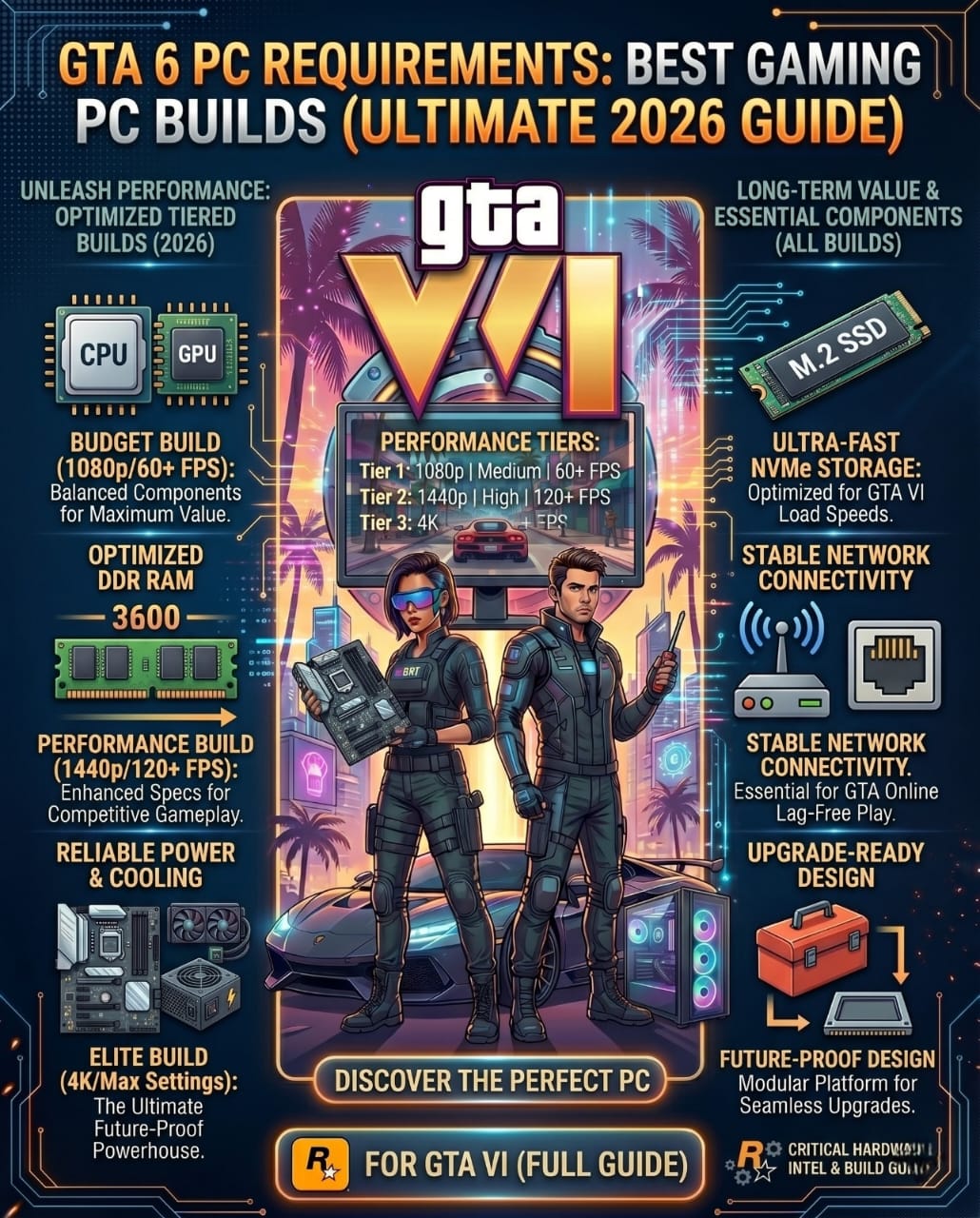
The countdown to the most anticipated video game release in history is well underway. As Rockstar Games prepares to take us back to the neon-drenched, chaotic streets of Vice City and the broader state of Leonida, PC gamers around the world are asking one crucial question: Will my rig be able to run GTA 6?
Historically, Rockstar Games pushes the absolute limits of gaming hardware with every major release. From the revolutionary physics of GTA IV to the breathtaking, photorealistic vistas of Red Dead Redemption 2, their titles serve as benchmark standards for years after launch. Grand Theft Auto VI will be no exception. Utilizing an upgraded iteration of the proprietary RAGE (Rockstar Advanced Game Engine), the game features unprecedented crowd density, hyper-realistic physics, volumetric weather systems, and ray-traced global illumination.
Because the PC version is slated to arrive shortly after the console launch, preparing your setup now is essential. This comprehensive guide breaks down the predicted GTA 6 PC requirements and provides three highly optimized, future-proof gaming PC builds designed to dominate Leonida at every resolution.
The Reality of GTA 6 on PC: Why It Will Tax Your Hardware
Before looking at spec sheets, we must understand why GTA 6 will be a hardware-melting title. Unlike cross-generational games of the past, GTA 6 is built exclusively for modern, high-tier hardware.
- Advanced AI and Simulation: Rockstar is famous for living, breathing worlds. In GTA 6, NPC AI, traffic patterns, wildlife behavior, and individual character routines will be simulated at a scale never seen before. This puts an immense burden on your CPU.
- Ray Tracing as a Baseline: Global illumination, reflections, and shadows in GTA 6 are designed around ray-tracing pipelines. Running the game with these features enabled will require dedicated hardware acceleration (RT cores).
- VRAM Consumption: With massive, seamless map transitions, ultra-high-resolution textures, and incredibly dense urban environments, Video RAM (VRAM) will be a major bottleneck. GPUs with only 8GB of VRAM will likely struggle at settings higher than "Medium."
Predicted GTA 6 PC System Requirements
Based on current technological trajectories, console hardware capabilities, and Rockstar's historical optimization patterns, here are the realistic predicted system requirements for GTA 6 on PC.
| Hardware Component |
Minimum Specs (1080p / 30-45 FPS, Low-Med) |
Recommended Specs (1440p / 60 FPS, High) |
Ultra/Ray-Tracing Specs (4K / 60+ FPS, Maxed) |
| OS |
Windows 10/11 (64-bit) |
Windows 11 (64-bit) |
Windows 11 (64-bit) |
| Processor (CPU) |
Intel Core i5-11600K / AMD Ryzen 5 5600X |
Intel Core i7-13700K / AMD Ryzen 7 7700X |
Intel Core i9-14900K / AMD Ryzen 7 7800X3D |
| Graphics (GPU) |
NVIDIA RTX 2060 Super / AMD RX 5700 XT |
NVIDIA RTX 4070 / AMD RX 7800 XT |
NVIDIA RTX 4090 / RTX 5080 |
| VRAM |
8 GB |
12 GB |
16 GB+ |
| System RAM |
16 GB DDR4 |
32 GB DDR5 |
32 GB / 64 GB DDR5 |
| Storage |
150 GB SSD (SATA) |
150 GB NVMe PCIe 4.0 SSD |
150 GB NVMe PCIe 5.0 SSD |
Deep Dive: Key Hardware Components for GTA 6
1. The CPU: The Heart of the Simulation
Do not cheap out on your processor. GTA 6 will feature highly complex physics and crowd densities that will bottleneck weaker CPUs. If you want a smooth, stutter-free 60+ FPS experience in dense downtown areas, you will need a modern processor with excellent single-core performance and at least 8 physical cores.
Top Pick: The AMD Ryzen 7 7800X3D (or its 9000-series successor) is the undisputed king of gaming CPUs, thanks to its massive 3D V-Cache which excels in open-world games.
2. The GPU & VRAM: Rendering Vice City
To experience the neon lights of Vice City with ray tracing enabled, your GPU must be a powerhouse.
Avoid 8GB GPUs for high settings. Modern games are already pushing past 10GB of VRAM at 1440p. For GTA 6, aim for a graphics card with at least 12GB of VRAM (like the RTX 4070) or 16GB (like the RX 7800 XT) to ensure textures load smoothly without hitching.
3. Storage: SSD is Non-Negotiable
You can completely forget about playing GTA 6 on a traditional Hard Disk Drive (HDD). The game will utilize high-speed asset streaming pipelines similar to PlayStation 5 and Xbox Series X. An M.2 NVMe SSD with a read speed of at least 5000 MB/s is mandatory to prevent texture pop-in and long loading screens.
Best Gaming PC Builds for GTA 6 (2026 Guide)
To help you prepare, we have curated three distinct PC builds tailored to different budgets and performance targets.
Build 1: The "Budget Vice" Build (Target: 1080p / 60 FPS / Medium-High Settings)
This build is designed for gamers who want a console-equivalent or slightly superior experience without breaking the bank. It utilizes highly cost-effective, modern components that still offer an upgrade path.
- CPU: AMD Ryzen 5 7600 (6 Cores / 12 Threads)
- GPU: NVIDIA RTX 4060 Ti (16GB Version) or AMD Radeon RX 7700 XT (12GB)
- Motherboard: Gigabyte B650M DS3H
- RAM: 32GB (2x16GB) Corsair Vengeance DDR5 6000MHz CL30
- Storage: 1TB Crucial P3 Plus PCIe 4.0 NVMe SSD
- Power Supply (PSU): Corsair CX650M 650W 80+ Bronze
- Case: Montech AIR 903 BASE (Excellent out-of-the-box airflow)
Build 2: The "Leonida Sweet Spot" Build (Target: 1440p / 60+ FPS / High Settings / Ray Tracing)
This is the optimal build for the majority of PC enthusiasts. It balances high-end performance with sensible pricing, allowing you to turn on ray tracing and enjoy high frame rates at 1440p.
- CPU: AMD Ryzen 7 7800X3D (The absolute best gaming CPU)
- GPU: NVIDIA GeForce RTX 4070 Super (12GB) or AMD Radeon RX 7900 GRE (16GB)
- CPU Cooler: Thermalright Peerless Assassin 120 SE
- Motherboard: MSI MAG B650 TOMAHAWK WIFI
- RAM: 32GB (2x16GB) G.Skill Trident Z5 Neo DDR5 6000MHz CL30
- Storage: 2TB Samsung 990 Pro PCIe 4.0 NVMe SSD
- Power Supply (PSU): Corsair RM750e 750W 80+ Gold (ATX 3.0 Compatible)
- Case: Corsair 4000D Airflow
Build 3: The "Grand Theft Ultra" Build (Target: 4K / 60+ FPS / Max Settings & Path Tracing)
If budget is no object and you want to experience GTA 6 exactly how the developers envisioned it—with jaw-dropping 4K resolution, maximum draw distances, and path-traced lighting—this is the ultimate weapon.
- CPU: AMD Ryzen 7 7800X3D (or next-gen Ryzen 9 9800X3D)
- GPU: NVIDIA GeForce RTX 4090 (24GB) or next-generation RTX 5080/5090
- CPU Cooler: NZXT Kraken Elite 360 RGB AIO Liquid Cooler
- Motherboard: ASUS ROG STRIX X670E-F GAMING WIFI
- RAM: 64GB (2x32GB) G.Skill Ripjaws S5 DDR5 6400MHz CL32
- Storage: 4TB WD Black SN850X PCIe 4.0 NVMe SSD
- Power Supply (PSU): Seasonic Vertex GX-1000 1000W 80+ Gold ATX 3.0
- Case: Lian Li O11 Dynamic EVO RGB
Future-Proofing Tips for GTA 6 on PC
- Embrace Upscaling Technologies: Technologies like NVIDIA DLSS, AMD FSR, and Intel XeSS are no longer optional extras; they are fundamental to modern game design. Ensure your next GPU supports the latest version of these upscalers to maximize performance.
- Monitor Your Thermals: High-end CPUs and GPUs generate massive amounts of heat under heavy loads. Ensure your PC case has excellent ventilation, mesh panels, and high-quality intake/exhaust fans to prevent thermal throttling during long GTA 6 play sessions.
- Invest in a Quality Power Supply (PSU): Modern GPUs are prone to transient power spikes. Always buy an 80+ Gold certified power supply from a reputable brand, and ensure it is ATX 3.0 certified if you are buying a newer NVIDIA GPU to avoid messy adapter cables.
Conclusion: Preparing for the Ultimate Sandbox Experience
Grand Theft Auto VI is set to redefine open-world gaming, but experiencing its true beauty requires a PC that is up to the challenge. By upgrading to a modern multi-core processor, securing a GPU with ample VRAM, and ensuring your storage relies on a lightning-fast NVMe SSD, you will be fully prepared to step into Leonida on day one.
Whether you build the budget-friendly "Budget Vice" rig or go all-out with the "Grand Theft Ultra" powerhouse, investing in high-quality hardware now ensures you won't be left in the dust when the PC launch arrives. Keep your drivers updated, monitor hardware releases as we approach 2026, and we'll see you in Vice City!
UPDATES ON GAMES & GAMING COMMUNITY
Nintendo Switch 2 Leaks, Specs, & Rumored Games: The Ultimate Guide
It has been over seven years since Nintendo revolutionized the gaming industry with the launch of the Nintendo Switch. By seamlessly blending home console gaming with handheld portability, the Switch became a cultural phenomenon, selling over 140 million units worldwide. However, as modern games push the boundaries of visual fidelity, the aging Tegra X1 processor inside the current Switch is showing its age.
Enter the highly anticipated Nintendo Switch 2 (a placeholder name used by fans and industry insiders alike).
The rumor mill is spinning at an all-time high. From developer leaks at major trade shows to shipping manifests and patent filings, we now have a highly detailed picture of what Nintendo’s next-gen console will look like. In this comprehensive guide, we will dive deep into the hardware speculations, rumored features, expected release dates, and the games that will define this next era of hybrid gaming.
1. Under the Hood: The Nintendo Switch 2 Hardware Specs
The biggest question surrounding the Nintendo Switch successor is how much of a generational leap it will offer. While Nintendo has never chased raw teraflops in the same way Sony and Microsoft do, the Switch 2 is poised to offer a massive jump in performance, largely thanks to its continued partnership with Nvidia.
The Nvidia T239 Chip: The Heart of the Console
According to multiple reputable leaks, the Nintendo Switch 2 will be powered by a custom Nvidia Tegra T239 chip. Built on a customized version of Nvidia’s Ampere architecture, this system-on-a-chip (SoC) will feature:
- An 8-core ARM Cortex-A78AE CPU.
- A GPU based on the Ampere architecture (similar to the RTX 30-series graphics cards).
- 12GB of LPDDR5 RAM (a massive upgrade from the original Switch's 4GB).
- Faster storage solutions, likely migrating from slow eMMC storage to high-speed PCIe Gen 4 SSDs or fast UFS 3.1 flash memory.
The Game-Changer: Nvidia DLSS and Ray Tracing
While the raw horsepower of the Switch 2 won't match the PlayStation 5 or Xbox Series X, it has a secret weapon: Nvidia DLSS (Deep Learning Super Sampling).
DLSS is an AI-driven upscaling technology that allows a device to render games at a lower internal resolution (saving battery life and processing power) and upscale the image to a crisp 4K resolution on your TV.
- Ray Tracing Support: Hardware-level ray tracing is rumored to be included, allowing for realistic lighting, reflections, and shadows.
- Target Performance: Insiders suggest the Switch 2 will target a smooth 1080p in handheld mode and up to 4K resolution when docked, utilizing DLSS reconstruction to deliver visuals that rival current-gen home consoles.
2. Design, Display, and the New Joy-Cons
Nintendo is unlikely to abandon the hybrid form factor that made the original Switch a monumental success. However, several physical upgrades are expected to modernize the device.
The Screen: Size vs. Technology
One of the most debated aspects of the Switch 2 leaks is the display. Industry analysts suggest that Nintendo will launch the system with an 8-inch LCD screen rather than an OLED panel.
While this may seem like a step backward for owners of the Nintendo Switch OLED model, it is a strategic business decision. Using an LCD screen allows Nintendo to keep the launch price of the console affordable while maximizing profit margins. An OLED version will almost certainly release later in the console's lifecycle.
Magnetic Joy-Con Controllers
Perhaps the most exciting design leak involves the iconic Joy-Con controllers. Patent filings and supply chain leaks indicate that Nintendo is abandoning the slide-rail mechanism of the current Joy-Cons in favor of a magnetic attachment system.
- Why the change? Magnetic connections could allow for a sleeker console design, sturdier attachments, and more ergonomic controller shapes.
- The downside: This change suggests that existing Joy-Cons may not physically slide onto the sides of the new console, though they will likely still connect wirelessly.
3. Backward Compatibility: Will Your Library Carry Over?
For millions of gamers, backward compatibility is a make-or-break feature. Fortunately, all signs point to Nintendo making the transition as seamless as possible.
According to developer leaks, the Nintendo Switch 2 will feature physical and digital backward compatibility.
- Physical Cartridges: The cartridge slot on the Switch 2 is rumored to accept original Nintendo Switch game cards.
- Digital Library: Your Nintendo Account and digital eShop purchases are expected to carry over directly to the new hardware.
- Next-Gen Patches: Much like the transition from PS4 to PS5, developers will likely be able to release performance patches for existing Switch games, allowing titles like The Legend of Zelda: Tears of the Kingdom to run at 60 FPS with improved resolutions on the new hardware.
4. Release Date and Pricing Speculation
The Release Window
Initially, rumors pointed to a late 2024 launch. However, recent reports from major publications like Bloomberg and Nikkei suggest that Nintendo has internally delayed the launch to early 2025.
This delay was reportedly enacted to achieve two main goals:
- Securing Stock: To avoid the hardware shortages and scalper issues that plagued the PS5 and Xbox Series X launches.
- Polishing the Software: To ensure a robust, blockbuster lineup of first-party games is ready for day one.
The Price Point
The original Switch launched at $299. Given inflation, rising manufacturing costs, and the upgraded internals, industry experts predict the Nintendo Switch 2 will retail between $399 and $449. This keeps it competitively priced below the PS5 and Xbox Series X while reflecting the premium nature of the new hardware.
5. The Game Lineup: Confirmed and Heavily Rumored Titles
A console is only as good as its games. While Nintendo has kept its official lineup under wraps, we can make highly educated guesses based on developer pipelines and historical release patterns.
| Game Title |
Status |
What to Expect |
| Metroid Prime 4: Beyond |
Confirmed |
Announced for the original Switch, this title is widely expected to be a cross-gen release, acting as a visual showcase for the Switch 2. |
| A New 3D Mario |
Heavily Rumored |
It has been years since Super Mario Odyssey. Rumors suggest a massive, open-zone 3D Mario game is being developed specifically as a launch title. |
| Mario Kart 9 (or Mario Kart X) |
Highly Likely |
Mario Kart 8 Deluxe is the best-selling game on the Switch. A brand-new entry built from the ground up for next-gen hardware is a top priority. |
| Super Smash Bros. Next-Gen |
Speculative |
While a new entry is inevitable, it may arrive later in the console's lifecycle, potentially starting with an enhanced port of Ultimate. |
| Third-Party Heavy Hitters |
Rumored |
With the addition of DLSS and more RAM, major third-party games like Monster Hunter Wilds and enhanced ports of Cyberpunk 2077 or Final Fantasy VII Remake are rumored to be in development for the system. |
Conclusion: A New Era of Hybrid Gaming Awaits
The anticipation surrounding the Nintendo Switch 2 is a testament to the incredible foundation Nintendo built in 2017. By preserving the hybrid philosophy while injecting modern technologies like Nvidia DLSS, ray tracing, and expanded RAM, Nintendo is positioning its next console to bridge the gap between casual portability and high-end home gaming.
While we must wait for an official Nintendo Direct announcement for concrete details, the leaks paint a picture of a console that is not trying to reinvent the wheel, but rather perfect it. If Nintendo can deliver backward compatibility, a killer launch lineup featuring Mario and Metroid, and a fair price point, the Switch 2 is destined to repeat—and perhaps even surpass—the monumental success of its predecessor.
Keep your eyes peeled; the next generation of Nintendo gaming is just around the corner.
The Return of Halo: How "Halo: Campaign Evolved" in Unreal Engine 5 Reboots the Franchise
For over two decades, the Halo franchise has stood as the undisputed vanguard of the sci-fi first-person shooter genre. From the moment players stepped onto the pristine, mysterious surface of Installation 04 in 2001, the green armor of the Master Chief became synonymous with Xbox gaming. However, the road since then has been marked by technological hurdles, creative shifts, and engine limitations that have left many fans yearning for a return to form.
That return is finally here, and it is powered by the most advanced real-time 3D creation tool on the planet.
With the rebranding of 343 Industries into Halo Studios and the official announcement of their transition to Epic Games' cutting-edge engine, a new chapter has begun. Dubbed by fans and industry insiders as the dawn of "Halo: Campaign Evolved (Unreal Engine 5)," this shift represents more than just a graphical upgrade—it is a complete, structural rebirth of the Master Chief’s universe.
In this deep-dive analysis, we will explore what this engine transition means for the future of Halo, analyze the visual and technical breakthroughs of "Project Foundry," and examine how Unreal Engine 5 will redefine the campaign experience for veteran Spartans and newcomers alike.
1. The Death of Slipspace: Why Halo Needed Unreal Engine 5
To understand why the transition to Unreal Engine 5 (UE5) is such a monumental milestone, we must first look at the technical challenges that plagued the franchise's recent history.
For years, Halo games were built on proprietary engines—first the Blam! engine, and later, the highly customized Slipspace Engine used for Halo Infinite. While Slipspace was designed to handle the vast, semi-open world of Zeta Halo, it came with massive development bottlenecks:
- Technical Debt: Decades-old legacy code made implementing minor changes incredibly time-consuming for developers.
- Onboarding Friction: New developers joining the studio had to spend months learning a highly complex, proprietary toolset instead of building the game.
- Content Pipelines: Creating high-fidelity assets and integrating them into the Slipspace Engine slowed production to a crawl, leading to long droughts in post-launch content.
By abandoning the Slipspace Engine in favor of Unreal Engine 5, Halo Studios has eliminated these roadblocks. UE5 is the industry standard, meaning the studio can recruit top-tier talent who can immediately begin working on the next-gen Halo experience without a steep learning curve. The focus has shifted from fighting the engine to crafting the game.
2. Project Foundry: A Glimpse into the Next-Gen Ringworld
Alongside the announcement of their engine shift, Halo Studios unveiled Project Foundry—a highly detailed research and development initiative designed to showcase what Halo looks like when built from the ground up in Unreal Engine 5.
Project Foundry is not just a pre-rendered cinematic; it is a fully playable technical showcase running in real-time. The assets created for this project are built to the exact specifications of what a future, next-gen Halo game will require. Three distinct biomes were showcased, each highlighting a different facet of the Halo universe:
The Pacific Northwest Biome
A direct homage to the classic landscapes of the original Halo: Combat Evolved, this environment features towering pine trees, rugged cliffs, and misty valleys.
- Nanite Virtualized Geometry: Every needle on the pine trees, every pebble on the ground, and the moss clinging to the rocks are rendered with millions of polygons. This eliminates "pop-in" and creates an unprecedented level of environmental realism.
- Lumen Global Illumination: Sunlight filters realistically through the dense forest canopy, bouncing off wet surfaces and casting soft, natural shadows that shift dynamically in real-time.
The Cold, Forerunner Architecture
The mysterious, metallic structures built by the ancient Forerunners have always been central to Halo's visual identity. Under UE5, these structures take on an entirely new level of scale and mystery.
- Reflective Surfaces: The brushed-metal surfaces of Forerunner corridors reflect the surrounding environment with pin-point accuracy, reacting dynamically to the glow of plasma fire and energy shields.
- Atmospheric Depth: Volumetric fog and dust motes drift through the ancient halls, giving these monumental structures a sense of age, weight, and history.
The Blighted Covenant Wasteland
A stark contrast to the lush forests, this biome showcases a harsh, alien landscape scarred by Covenant plasma bombardment.
- Deformable Terrain: The ground reacts dynamically to explosions and vehicular movement.
- Alien Flora: Bizarre, bioluminescent plants cast their own light sources, creating a hauntingly beautiful, hostile atmosphere that feels truly extraterrestrial.
3. Reimagining the Master Chief: Armor and Realism
In any Halo campaign, the Master Chief is the anchor of the narrative. In Halo: Campaign Evolved (Unreal Engine 5), the iconic MJOLNIR armor has received a breathtaking level of detail.
[Legacy Armor Rendering] ──► Flat textures, baked lighting, limited wear-and-tear
[UE5 MJOLNIR Rendering]  ──► Micro-surface scratches, dynamic dirt buildup, realistic metal-on-metal reflections
Using UE5’s advanced material pipelines, developers can render the Master Chief’s armor with physical accuracy. You can see the individual scuffs from plasma burns, the metallic sheen of the titanium alloy, and the reflection of the surrounding environment on his gold-colored visor.
This visual fidelity extends to the alien enemies as well. The Covenant Elite’s armor gleams with pearlescent paint, while the coarse, leathery skin of the Brutes reacts realistically to light, sweat, and battle damage.
4. Gameplay Implications: How UE5 Changes the Sandbox
Halo has always been defined by its sandbox gameplay—the chaotic, unscripted interactions between player choice, enemy AI, physics, and vehicular combat. A common concern among purists is whether Unreal Engine 5 can replicate the unique "feel" of Halo physics.
Halo Studios has addressed this head-on. While UE5 handles the rendering, lighting, and world-building, the underlying gameplay logic, movement physics, and AI behaviors are being meticulously tuned to preserve the classic Halo identity.
However, UE5 introduces several game-changing enhancements to the sandbox:
- Seamless Worlds: Thanks to UE5's World Partition system, future campaigns can feature massive, seamless environments without loading screens. Players can transition from tight, claustrophobic Forerunner tunnels to sprawling, open-world battlefields instantly.
- Destructible Environments: Utilizing the Chaos Physics system, battles will leave a permanent mark on the environment. Cover can be chipped away by heavy plasma fire, and vehicles will deform and break apart with realistic debris.
- Advanced AI Pathfinding: Unreal Engine 5 allows for more complex, dynamic AI pathfinding. Covenant forces will navigate rugged, vertical terrain more intelligently, flanking the player and utilizing the environment in ways never before possible.
5. The Strategic Rebranding: Halo Studios’ New Philosophy
The transition to Unreal Engine 5 is accompanied by a profound cultural shift within the studio. By rebranding from 343 Industries to Halo Studios, Microsoft is signaling a clean slate.
Under this new philosophy, the studio is moving away from the "live-service" pressure cooker that hindered Halo Infinite's launch. Instead, they are focusing on multiple, dedicated projects built on a unified engine. This means the team can work on a mainline sequel, a spin-off, or even a remake simultaneously, sharing assets and technological breakthroughs seamlessly across projects.
What This Means for the Release Timeline
Because Unreal Engine 5 drastically reduces development time, we can expect a more consistent release schedule. While a brand-new, mainline Halo game is still several years away, the efficiency of UE5 means that pre-production and active development will move at a pace previously thought impossible for a franchise of this scale.
Conclusion: A Bright, Next-Gen Future for the Master Chief
The transition to Halo: Campaign Evolved (Unreal Engine 5) is more than a mere technological upgrade; it is a declaration of intent. Halo Studios is stripping away the technical limitations of the past to give developers the freedom to create the ultimate sci-fi experience.
By leveraging the power of Nanite, Lumen, and Chaos Physics, the next generation of Halo promises to deliver the jaw-dropping visual wonder that players felt when they first looked up at the skybox of the Ringworld in 2001. The Master Chief is ready for his next mission, and with Unreal Engine 5, his universe has never looked more alive.
Unreal Engine 5 Next-Gen Horror: The Mind-Blowing Future of Resident Evil Code: Veronica & Alien: Isolation 2
The survival horror genre is standing on the precipice of a terrifying new dawn. For decades, developers have relied on clever camera angles, scripted jump scares, and atmospheric fog to mask technical limitations and induce fear. Today, however, the paradigm has shifted.
With the advent of Epic Games’ Unreal Engine 5 (UE5), the line between interactive entertainment and photorealistic nightmare has officially blurred.
Among the most anticipated prospects in this new era of gaming are two titans of terror: a next-gen reimagining of the cult classic Resident Evil Code: Veronica and the heavily demanded, recently greenlit sequel Alien: Isolation 2. By leveraging the bleeding-edge architecture of UE5, these titles are poised to redefine what it means to experience psychological dread.
In this deep dive, we will explore how Unreal Engine 5 is transforming the landscape of next-gen horror, what a modern Code: Veronica could look like under this engine, and how Alien: Isolation 2 will utilize advanced technology to make the cosmos more terrifying than ever before.
1. The Unreal Engine 5 Revolution in Survival Horror
To understand why the future of horror is so bright—and incredibly dark—we must first look at the core technologies powering Unreal Engine 5. Fear is deeply rooted in sensory perception; our brains react to the subtle play of light, the density of shadows, and the realism of human expression. UE5 attacks these sensory inputs with unprecedented precision through several key proprietary technologies.
Lumen: Dynamic Global Illumination and Reflections
In horror, light is safety, and darkness is the enemy. Lumen is UE5’s fully dynamic global illumination and reflections system.
- Real-Time Light Bounce: Traditionally, developers had to "bake" lighting into scenes—a static process that couldn't react to dynamic changes. With Lumen, if a player knocks over a flickering lantern on Rockfort Island, the light bounces off wet stone walls, casting realistic, moving shadows in real-time.
- Oppressive Darkness: Lumen allows for true, pitch-black environments where the only illumination comes from a player’s flashlight. This creates an unparalleled sense of claustrophobia and vulnerability.
Nanite: Virtualized Micropolygon Geometry
Nanite removes polygon budget constraints, allowing artists to import film-quality 3D assets directly into the game engine.
- Hyper-Detailed Environments: From the rusted, decaying metal of a Weyland-Yutani space station to the intricate, gothic architecture of the Ashford Mansion, Nanite renders microscopic details without sacrificing performance.
- Elimination of Pop-in: Horror relies on immersion. Seeing a low-resolution texture suddenly pop into high detail ruins the illusion. Nanite ensures that every asset, near or far, maintains flawless fidelity.
2. Resident Evil Code: Veronica – A Next-Gen Remake Reimagined
While Capcom has achieved massive success with its proprietary RE Engine for titles like the Resident Evil 4 Remake, the sheer graphical potential of Unreal Engine 5 has led fans and indie creators to develop jaw-dropping concept builds of a Resident Evil Code: Veronica Remake in UE5.
Originally released in 2000, Code: Veronica is widely considered the true sequel to Resident Evil 2. It follows Claire Redfield as she searches for her brother Chris, leading her to the desolate Rockfort Island and a secret Umbrella facility in Antarctica.
+-------------------------------------------------------------+
| ROCKFORT ISLAND: THEN VS. NOW                               |
+----------------------------------+--------------------------+
| Dreamcast Original (2000)        | Unreal Engine 5 Concept  |
+----------------------------------+--------------------------+
| Static pre-rendered backgrounds  | Fully dynamic 3D spaces  |
| Flat, baked lighting             | Real-time Lumen shadows  |
| Low-poly character models        | Metahuman realism        |
| Scripted, static fog             | Volumetric, reactive fog |
+----------------------------------+--------------------------+
Visualizing Rockfort Island through Lumen and Nanite
Imagine stepping onto the shores of Rockfort Island. In a UE5-powered remake, the stormy weather isn't just a visual overlay; it is a fully simulated environment.
- Volumetric Weather Systems: Rain clings to Claire's leather jacket, dripping realistically down her face.
- Dynamic Destruction: As explosions rock the military training facility, Nanite-driven debris scatters realistically, altering the layout of the environment and forcing players to find new escape routes on the fly.
- Gothic Dread: The Ashford Mansion, with its taxidermy-lined walls and dusty chandeliers, benefit immensely from Lumen. The soft glow of fireplace embers casts long, dancing shadows of stuffed predators across the room, constantly tricking the player's eyes into seeing movement.
Metahumans and the Horror of the Ashford Twins
The psychological horror of Code: Veronica relies heavily on its antagonists, Alfred and Alexia Ashford. Using Epic's MetaHuman technology, developers can create digital humans with photorealistic skin textures, lifelike eye reflections, and highly expressive facial animations.
- Conveying Madness: The subtle twitch of Alfred’s eye or the cold, calculated smirk of Alexia can be rendered with cinematic clarity.
- Empathetic Terror: Players will be able to see the genuine panic, exhaustion, and pain in Claire Redfield's face as she fights to survive, deepening the emotional connection and stakes of the narrative.
3. Alien: Isolation 2 – Perfecting the Xenomorph in Next-Gen
When Creative Assembly released Alien: Isolation in 2014, it was hailed as a masterpiece of tension. The game’s success lay in its revolutionary, unscripted Xenomorph AI. Now, with a confirmed sequel on the horizon, Alien: Isolation 2 combined with Unreal Engine 5 has the potential to create the most terrifying gaming experience in history.
The Ultimate Predator: Advanced AI and Pathfinding
Unreal Engine 5’s advanced processing capabilities allow for more complex AI behavior trees. In Alien: Isolation 2, the Xenomorph will no longer just react to sound queues; it will actively learn from the player's habits with terrifying efficiency.
- Adaptive Hunting: If you hide in lockers too often, the Xenomorph will begin checking them first. If you rely heavily on the motion tracker, the creature might learn to listen for its distinct beep.
- Fluid Movement Dynamics: Using UE5's advanced physics and animation warping, the Xenomorph can traverse the environment with unparalleled fluidity. It can slip through vents, scale walls, and drop from ceilings seamlessly, making its movement look organic, unpredictable, and deeply unsettling.
Environmental Storytelling in Retro-Futurism
The Alien franchise is defined by its "used future" aesthetic—industrial, analog, and grimy.
- The Nostromo Legacy: Utilizing Nanite, the sequel can render hyper-detailed retro-futuristic technology. Think CRT monitors with realistic screen curvature and glass glare, greasy hydraulic pistons, and massive, complex server banks.
- Smoke, Steam, and Light: Space stations are filled with hazards. With UE5's Niagara VFX system, dynamic steam vents can obscure the player's vision, while emergency strobe lights interact with the smoke, creating a disorienting, strobe-lit nightmare where the Xenomorph could be hiding in plain sight.
4. The Technical Pillars of Next-Gen Horror
To truly appreciate what Unreal Engine 5 brings to the table for both Resident Evil Code: Veronica and Alien: Isolation 2, we must look at the underlying technical pillars that make next-gen horror so uniquely terrifying.
1. Spatial Audio and Acoustic Simulation
Sound design is 50% of the horror experience. UE5’s built-in audio engine, MetaSounds, allows for physical acoustics simulation.
- Dynamic Echoes: In Alien: Isolation 2, the sound of a metal pipe clanging will echo differently depending on whether you are in a tight, carpeted crew quarter or a massive, steel cargo bay.
- Directional Audio cues: Players can pinpoint the exact vent the Xenomorph is crawling through, or hear the wet, dragging footsteps of a zombie approaching from around a blind corner in Code: Veronica.
2. Temporal Super Resolution (TSR)
Horror games require high performance to maintain immersion. Framerate drops pull players out of the experience. Temporal Super Resolution (TSR) is Epic’s native upscaling technology. It allows games to render at lower resolutions to save processing power, then upscale to 4K with virtually no loss in visual quality. This ensures that even with ray tracing, Lumen, and Nanite fully active, players can experience next-gen horror at a buttery-smooth 60 frames per second.
3. Physics-Based Interactions
With UE5's Chaos Physics engine, the environment becomes a physical participant in the horror.
- Destructible Environments: Barricading a door in Code: Veronica feels desperate as zombies realistically splinter the wood paneling piece by piece.
- Ragdoll and Impact Realism: Combat feels heavier and more consequential. Every bullet impact on a creature's flesh reacts dynamically, showing realistic entry wounds and tissue damage.
Conclusion: A New Era of Dread Awaits
The future of survival horror is not merely about higher resolutions or faster loading times; it is about unprecedented immersion.
As we look forward to the potential of a Resident Evil Code: Veronica Remake and the confirmed development of Alien: Isolation 2, the integration of Unreal Engine 5 represents a monumental leap forward. By combining the photorealistic geometry of Nanite, the terrifyingly realistic lighting of Lumen, and the lifelike emotional delivery of MetaHumans, developers now possess the ultimate toolkit to prey on our deepest phobias.
Whether you are navigating the decaying, gothic corridors of Rockfort Island or hiding in the cold, metallic shadows of a derelict space station, one thing is certain: next-gen horror is going to be beautiful, immersive, and absolutely terrifying. Prepare yourselves—the dark has never looked so real.
The Rise of UGC Monetization: How Roblox, Fortnite, and Genshin Impact are Empowering a New Generation of Creators

The gaming landscape is undergoing a massive paradigm shift. For decades, the relationship between game developers and players was strictly transactional: developers built the worlds, and players paid to experience them.
Today, that boundary has completely dissolved. We have officially entered the era of User-Generated Content (UGC) monetization, a booming sector within the broader creator economy that is transforming passionate gamers into highly profitable digital entrepreneurs.
From teenage developers earning millions on Roblox to seasoned 3D artists leveraging Fortnite’s Unreal Editor, the democratization of game development tools has unlocked unprecedented financial opportunities. Even traditional, narrative-driven titles like Genshin Impact are finding innovative ways to leverage community-driven content to fuel their ecosystems.
In this comprehensive deep-dive, we will explore how Roblox, Fortnite, and Genshin Impact are pioneering unique blueprints for UGC monetization, the technology driving this revolution, and what the future holds for creators looking to monetize their virtual creations.
1. The Evolution of Gaming Economies: From Modding to Mainstream Monetization
To understand the scale of the current UGC revolution, we must first look at its roots.
Historically, user-generated content existed in the form of "mods" (modifications). Passionate communities created custom maps, skins, and gameplay mechanics for titles like Doom, Half-Life (which birthed Counter-Strike), and Minecraft. However, these creators rarely saw a dime for their labor. Modding was a labor of love, often relegated to grey-market donation buttons or portfolio building.
The modern virtual goods market has changed the rules of engagement. Today’s gaming platforms are no longer just games; they are foundational operating systems. By providing creators with proprietary development suites, cloud hosting, and direct monetization pipelines, platforms have turned game design into a viable, highly lucrative career path.
2. Roblox: The Pioneer of the In-Game Creator Economy
When discussing UGC monetization, Roblox is the undisputed trailblazer. Launched in 2006, the platform has evolved from a physics sandbox into a global powerhouse boasting over 70 million daily active users (DAUs).
The Robux Ecosystem and the Developer Exchange (DevEx)
At the heart of Roblox’s financial engine is Robux, the platform’s proprietary virtual currency. Players purchase Robux with real-world fiat currency to buy in-game experiences, avatar cosmetics, and private servers.
Creators monetize their work through several avenues:
- Paid Access: Charging players an upfront Robux fee to play a game.
- Microtransactions (Game Passes & Developer Products): Selling double-jump abilities, custom weapons, or cosmetic enhancements within their games.
- The UGC Catalog: Independent 3D artists can design and sell virtual clothing, accessories, and animations directly to the global Roblox player base.
Through the Developer Exchange (DevEx) program, creators cash out their earned Robux into real-world currency. While the platform's revenue split has historically faced scrutiny (with creators receiving roughly 29% of the platform's total revenue pie), the absolute volume of payouts is staggering. In recent years, Roblox has paid out hundreds of millions of dollars annually to its developer community, with top-tier development studios clearing seven-figure revenues.
3. Fortnite & UEFN: Epic Games’ Multi-Billion Dollar Bet on Creator Economy 2.0
For years, Fortnite was known strictly as a world-conquering Battle Royale. However, Epic Games’ long-term vision was always to transition Fortnite into a massive, interconnected metaverse platform.
That vision became a reality with the launch of the Unreal Editor for Fortnite (UEFN), also known as Creative 2.0.
Engagement Payouts: A New Way to Get Paid
Unlike Roblox, where creators must actively sell items or access to make money, Epic Games introduced a disruptive model called Creator Economy 2.0.
Under this system, Epic distributes 40% of Fortnite’s net revenue back to eligible island creators. These payouts are calculated based on player engagement metrics, including:
- Player Retention: How often players return to a specific creator's island.
- Player Attraction: The number of new players a custom map draws into the Fortnite ecosystem.
[Fortnite Net Revenue Pool] ➡️ [40% Allocated to Creators] ➡️ [Distributed via Engagement Metrics (Retention + Attraction)]
This model democratizes monetization. A developer doesn't need to design complex microtransactions or monetization loops. If they build a highly engaging, fun game—whether it's a tactical shooter, a puzzle game, or a virtual concert—Epic Games pays them directly based on the time players spend in their world.
With UEFN allowing creators to import custom 3D models, animations, and audio using industry-standard Unreal Engine tools, the line between indie game development and Fortnite map creation has officially been erased.
4. Genshin Impact: The Fan-Merchandise and Community-Led UGC Model
At first glance, HoYoverse’s blockbuster action-RPG Genshin Impact seems like an odd fit for a discussion on UGC monetization. It is a highly polished, single-player/co-op live-service game with no built-in level editors or public coding sandboxes.
Yet, Genshin Impact represents a highly innovative, external UGC monetization model that leverages community passion and intellectual property (IP) licensing.
The Progressive IP Guidelines of HoYoverse
Most gaming giants guard their intellectual property with aggressive legal teams, issuing cease-and-desist letters to anyone selling fan art or unofficial merchandise. HoYoverse took the exact opposite approach.
Recognizing that fan-generated content is the lifeblood of community engagement and long-term player retention, HoYoverse released incredibly progressive Overseas Fan-Made Merchandising Guides. Under these guidelines:
- Physical Fan Art Monetization: Individual creators and fan groups are officially permitted to create and sell physical merchandise (such as acrylic stands, keychains, fan-art books, and plushies) featuring Genshin Impact characters.
- Low-Barrier Licensing: For small-scale production runs (typically under 200 to 500 units depending on the product category), creators do not need to pay royalties or seek official permission. For larger commercial runs, HoYoverse provides an accessible, official application process.
By allowing artists, writers, and crafters to legally monetize their love for the game's characters, HoYoverse has fostered a massive, self-sustaining community ecosystem. This "grey market made legal" keeps Genshin Impact constantly trending across social media platforms like X (formerly Twitter), TikTok, and Etsy, driving organic user acquisition without costing the developer a single advertising dollar.
5. Comparative Analysis: How the Giants Stack Up
To better understand the landscape, let's compare how these three giants approach UGC monetization:
| Feature |
Roblox |
Fortnite (UEFN) |
Genshin Impact |
| Primary Monetization Tool |
In-game microtransactions, virtual clothing sales |
Platform engagement payouts (40% net pool) |
Physical/digital fan merchandise & art sales |
| Target Creator Demographic |
Indie developers, 3D modelers, young coders |
Game designers, level creators, 3D artists |
Illustrators, crafters, writers, cosplayers |
| Development Environment |
Roblox Studio (Lua) |
Unreal Editor for Fortnite (Verse / C++) |
External creative software (Blender, Photoshop, etc.) |
| IP Accessibility |
Open to platform-native assets; strict copyright on external IPs |
Strictly regulated within Epic's guidelines |
Highly permissive, official fan-merch licensing |
6. The Technology and Trends Driving the UGC Boom
The explosive growth of user-generated content monetization is not happening in a vacuum. It is being propelled by several key technological advancements and industry shifts:
- No-Code and Low-Code Democratization: Tools are becoming increasingly intuitive. AI-assisted coding and asset generation are lowering the barrier to entry, allowing creative individuals without formal computer science degrees to bring their visions to life.
- The Rise of "Web2.5" Virtual Economies: While Web3 and blockchain gaming promised digital ownership, Web2.5 platforms like Roblox have quietly built robust, centralized virtual economies that work seamlessly for millions of mainstream users daily.
- The Virtual Fashion Revolution: High-end luxury brands like Gucci, Nike, and Ralph Lauren are actively partnering with UGC creators on Roblox and Fortnite to design virtual apparel, proving that digital identity is just as valuable as physical identity to Gen Z and Gen Alpha.
7. Challenges and Obstacles in the UGC Space
Despite the massive financial potential, the UGC monetization ecosystem is not without its hurdles. Aspiring creators and platforms must navigate several complex challenges:
Platform Dependency and Fee Splits
Creators are entirely at the mercy of the host platform's algorithms, policies, and payout percentages. If Roblox decides to adjust its DevEx conversion rate, or if Epic Games tweaks its engagement payout formula, a creator's monthly revenue can fluctuate wildly overnight.
Moderation and Safety
With millions of user-submitted assets uploaded daily, policing content for copyright infringement, offensive material, and malicious code is a monumental task. Platforms must invest heavily in automated AI moderation and human review teams to maintain brand safety.
Exploitation of Young Labor
Roblox, in particular, has faced criticism regarding the monetization of games developed by minors. Ensuring that young creators are fairly compensated, protected from predatory contracts, and not subjected to "crunch" culture is an ongoing ethical challenge for the industry.
Conclusion: The Future is User-Generated
The rise of UGC monetization represents a fundamental democratization of the gaming industry. We are moving away from a world where a select few gaming conglomerates control what we play, and toward a decentralized future where the players themselves build, govern, and profit from the virtual worlds they inhabit.
Whether you are a programmer writing code in Roblox Studio, a level designer sculpting terrains in Fortnite’s UEFN, or an illustrator selling fan-made prints of Genshin Impact characters, the opportunities to monetize your creativity have never been greater.
As technology continues to evolve and platforms refine their financial models, the creator economy in gaming is poised to scale to heights once thought impossible. The virtual gold rush is officially on—and the next generation of gaming empires will be built not by massive studios, but by the community.
The Death of the Loot Box: Inside the Anti-Gacha Revolution in Live Service Games
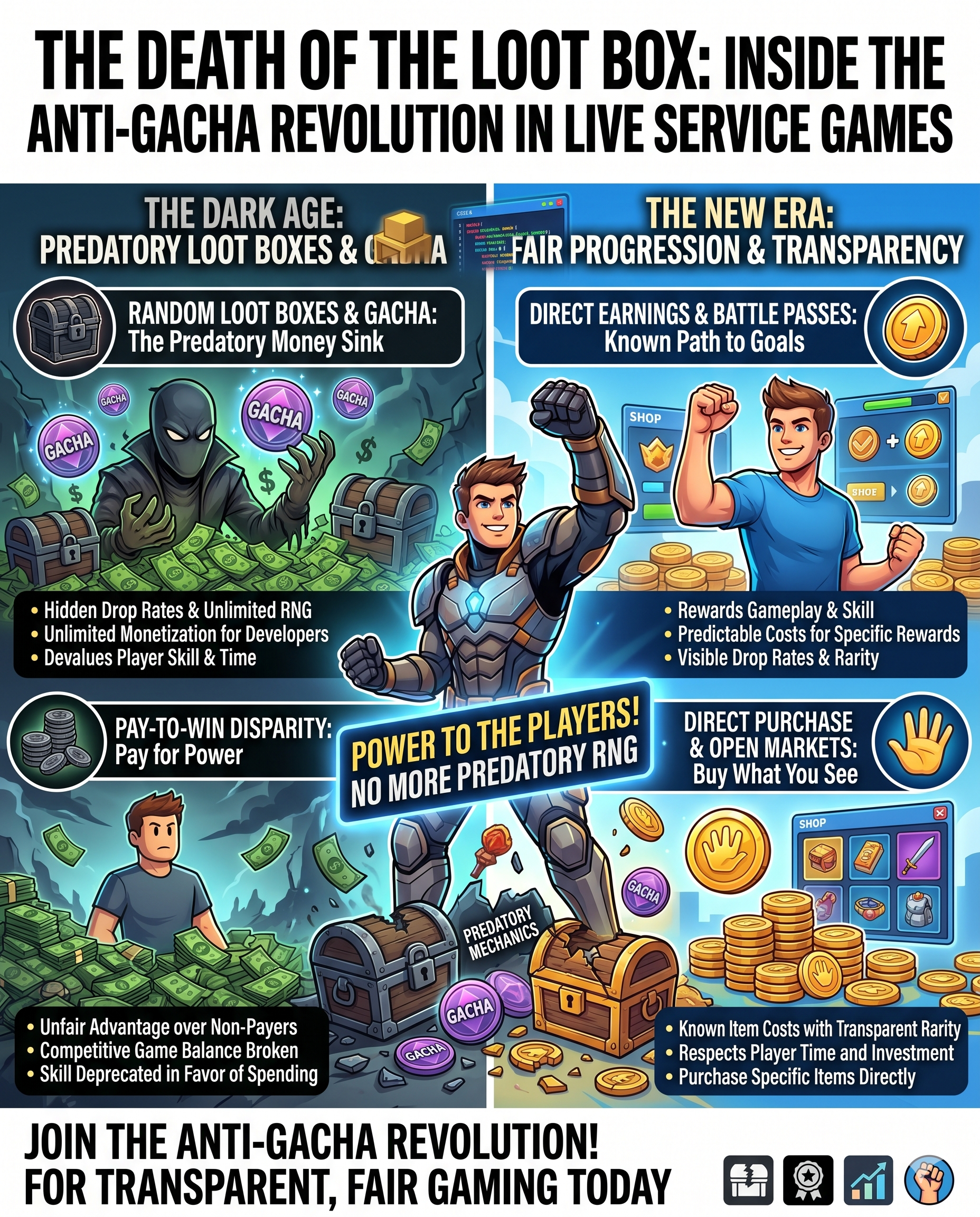
For nearly a decade, the video game industry operated under a highly lucrative, albeit controversial, golden rule: monetize the player base at all costs.
The rise of live service games (Games as a Service, or GaaS) transformed how developers designed, released, and maintained video games. Instead of a one-time $60 purchase, games became evolving ecosystems designed to be played—and monetized—for years. At the heart of this business model lay two incredibly powerful, psychologically manipulative mechanics: loot boxes and gacha systems.
However, the tide has officially turned. What began as quiet grumbling on Reddit forums has erupted into a full-scale global revolt. Today, we are witnessing the rise of the "Anti-Gacha" and "Anti-Loot Box" movement—a cultural, legal, and player-led revolution that is forcing the gaming industry to completely rethink how it treats its audience.
In this deep dive, we will explore the psychology behind these predatory monetization models, the legal crackdowns reshaping global markets, the rise of ethical monetization alternatives, and what the future holds for live service gaming.
1. The Psychology of the Pull: Why Loot Boxes Dominated Gaming
To understand the anti-gacha movement, we must first understand why these mechanics were implemented in the first place. At their core, loot boxes and gacha pulls are digital slot machines.
The Science of Variable Ratio Reinforcement
Loot boxes rely on a psychological concept known as variable ratio reinforcement. This is the exact same psychological trigger that makes casino slot machines so addictive. When a player opens a loot box, they do not know if they will receive a worthless cosmetic item or an ultra-rare, game-changing weapon.
- The Dopamine Hit: The anticipation of the reward releases dopamine in the brain. Interestingly, the dopamine spike is higher during the anticipation of the pull than during the actual reward itself.
- The "Near-Miss" Effect: Gacha games are masters of showing players how close they were to winning a highly coveted character, encouraging "just one more pull."
The Turning Point: Star Wars Battlefront II (2017)
While games like Team Fortress 2 and Overwatch popularized cosmetic loot boxes, EA’s Star Wars Battlefront II in 2017 pushed the player base past its breaking point.
Unlike previous games where loot boxes were purely cosmetic, Battlefront II locked iconic characters like Darth Vader and crucial gameplay upgrades behind randomized loot crates. Players calculated that it would take either 40 hours of gameplay or hundreds of real-world dollars to unlock a single hero.
The backlash was historic. A community manager's response on Reddit defending the grind as a way to provide players with "a sense of pride and accomplishment" became the most downvoted comment in Reddit history, securing over 660,000 downvotes.
This moment catalyzed the anti-loot box movement, transforming it from a niche player complaint into a mainstream political and social issue.
2. The Regulatory Hammer: Government Intervention on a Global Scale
As player outrage grew, governments around the world began investigating whether these microtransactions constituted illegal, unregulated gambling—especially when marketed to children.
GLOBAL REGULATORY LANDSCAPE
┌─────────────────────────┬──────────────────────────────────────────┐
│ Region                  │ Regulatory Stance                        │
├─────────────────────────┼──────────────────────────────────────────┤
│ Belgium & Netherlands   │ Strict Ban (Loot boxes deemed gambling)  │
│ China                   │ Mandatory Drop Rate Disclosures & Caps   │
│ European Union          │ Moving toward unified consumer protection│
│ United States (FTC)     │ Increased scrutiny; ESRB warning labels  │
└─────────────────────────┴──────────────────────────────────────────┘
The European Vanguard
In 2018, the Belgian Gaming Commission and the Dutch Gaming Authority declared that certain types of loot boxes violated their national gambling laws. They argued that because the digital items had a perceived monetary value and were acquired through chance, they met the legal definition of games of chance.
As a result, major publishers like EA, Valve, and Blizzard had to disable paid loot boxes in these regions or pull their games from the market entirely.
China's Structural Restrictions
China, one of the largest gaming markets in the world, took a different approach. The government mandated that game developers must:
- Disclose exact drop rates (the mathematical probability of winning each item).
- Implement spending limits and "pity systems" (guaranteeing a high-value item after a set number of failed attempts).
- Limit the daily play time for minors to curb gaming addiction.
The Ripple Effect in the West
While the United States and the United Kingdom have been slower to pass outright bans, the threat of legislation has forced self-regulation. The ESRB (Entertainment Software Rating Board) and PEGI introduced mandatory warning labels on physical and digital game boxes, explicitly stating if a game contains "In-Game Purchases (Includes Random Items)."
3. The Rise of "Ethical Monetization" and Alternative Models
Fearing government bans and facing intense consumer backlash, forward-thinking developers began looking for alternative ways to fund their live service games. This search birthed several modern monetization models that respect the player's wallet while still maintaining profitability.
The Battle Pass Model: Transparency Over Chance
Pioneered by games like Dota 2 and popularized on a massive scale by Fortnite, the Battle Pass has largely replaced the traditional loot box.
- How it works: Players pay a flat fee (typically around $10) for a seasonal pass. They then unlock a linear track of rewards by playing the game and completing challenges.
- Why players prefer it: It eliminates randomness. Players know exactly what rewards they are purchasing and what is required to unlock them.
Direct-Purchase Cosmetics
Instead of buying a randomized crate hoping to get a specific skin, games like Valorant and League of Legends rely heavily on direct-purchase storefronts. While these storefronts often utilize artificial scarcity (rotating stock) and premium virtual currencies to obscure the real-world cost, they are still widely considered a massive step up from loot boxes because what you see is what you buy.
The "Pay-to-Progress" vs. "Pay-to-Win" Divide
The anti-gacha movement has drawn a hard line between acceptable monetization and predatory practices:
- Pay-to-Win (P2W): Purchasing power, stats, or exclusive gear that gives players a direct competitive advantage. This is universally loathed by the gaming community.
- Pay-to-Progress / Convenience: Purchasing time-savers (like XP boosts) or inventory space. While still scrutinized, this is generally tolerated in free-to-play PvE (Player vs. Environment) games, provided the base game remains fun without spending money.
4. Case Studies: The Heroes and Villains of Modern Monetization
To understand how the market is reacting to this cultural shift, let's look at how different games have approached monetization in the modern era.
The Success Story: Helldivers 2
Released in early 2024, Arrowhead Game Studios' Helldivers 2 became an overnight sensation, praised not just for its chaotic cooperative gameplay, but for its incredibly consumer-friendly live service model.
- No FOMO (Fear Of Missing Out): The game's Battle Passes (called "Warbonds") never expire. Players can purchase them and complete them at their own pace, entirely eliminating the predatory pressure tactics used by other live service titles.
- Earnable Premium Currency: The premium currency, Super Credits, can be easily found in-game through normal play.
- The Result: High player retention, glowing critical reviews, and massive sales driven by positive word-of-mouth.
The Success Story: Path of Exile
Grinding Gear Games’ Path of Exile has maintained a highly profitable, free-to-play action RPG ecosystem for over a decade. Their philosophy is simple: sell only cosmetics and quality-of-life utility (like extra inventory stash tabs). They have proven that a game can thrive financially without locking power behind a paywall.
The Backlash: Diablo Immortal
In stark contrast, Blizzard’s Diablo Immortal launched to immense criticism. While the game was free-to-play, math-heavy analysis by players revealed that fully maximizing a single character's endgame gear could cost upwards of $110,000 in real-world money through complex, layered gacha mechanics. Despite making millions of dollars, the game suffered severe brand damage and a historically low user score on Metacritic.
5. The Future of Live Service Monetization: What Lies Ahead?
The anti-gacha movement is not just a passing trend; it is a permanent paradigm shift. As the gaming demographic matures, players are demanding more respect for both their time and their money.
So, what does the future of live service gaming look like?
- The Rise of "Buy-to-Play" Live Services: We will likely see more games adopt the Helldivers 2 or Guild Wars 2 model—a reasonable upfront purchase price coupled with fair, non-intrusive, and non-randomized monetization.
- Increased Platform Regulation: Apple and Google are facing pressure to further regulate gacha games on mobile devices. Expect stricter age-verification processes and easier refund policies for accidental purchases made by minors.
- AI-Driven Personalization: Instead of randomized loot boxes, future games may use machine learning to offer players highly personalized, direct-purchase bundles based on their specific playstyles and favorite characters.
Conclusion: The Power of the Player Voice
The "Anti-Gacha / Anti-Loot Box" movement is a testament to the power of collective consumer action. By voting with their wallets, organizing online, and capturing the attention of global legislators, gamers have successfully forced a multi-billion-dollar industry to pivot away from its most predatory practices.
While microtransactions are unlikely to disappear entirely—after all, keeping servers running and development teams employed requires continuous revenue—the era of the unregulated, predatory digital casino in mainstream video games is rapidly drawing to a close.
The future of live service games belongs to developers who understand that the most valuable resource in gaming isn't a player's wallet—it's their trust.